
Getting AI into the business is becoming easier. Making it work across the enterprise is where things get harder.

McKinsey’s State of AI research found that 88% of organizations regularly use AI in at least one business function. Yet only 7% say AI has been fully scaled across their organization. McKinsey notes that broadening AI use may require businesses to redesign workflows around AI capabilities and establish platforms that allow them to operate at scale. [1]
That gap becomes even more interesting as AI moves from generating content and answering questions to taking action.
McKinsey’s 2026 research found that nearly two-thirds of enterprises have experimented with AI agents, but fewer than 10% have scaled them to deliver tangible value. The research points to data, workflow, architecture and operating-model foundations as important factors in scaling agentic AI. [2]
As AI becomes more widely adopted, the bigger issue is how deeply it becomes part of the way people work, how business processes run, and how enterprise applications are built.
And that raises a more important question:
What do we need to build around AI agents for them to become useful enterprise capabilities?
Getting access to AI is becoming easier. Turning it into something that works reliably across a real business, with real people, processes and systems, is a different challenge.
AI Agents Are Moving Into the Enterprise
AI agents are changing the conversation around enterprise AI.
Unlike a traditional chatbot that primarily responds to prompts, an AI agent can reason through a goal, plan a sequence of actions, use tools and act on behalf of a user or organization.
Organizations are already experimenting with this model. McKinsey found that 62% of respondents say their organizations are at least experimenting with AI agents, while 23% report that they are scaling an agentic AI system somewhere in the enterprise. [3]
IDC reports that 42% of enterprises already have AI agents in production, with another 40% planning to follow within the next year. IDC also predicts that agentic automation will enhance the capabilities of more than 40% of enterprise applications by 2027. [4]
Gartner is seeing a similar direction. It predicts that 40% of enterprise applications will be integrated with task-specific AI agents by the end of 2026, up from less than 5% in 2025. Gartner describes this shift as moving enterprise applications beyond individual productivity toward teamwork, workflow and smarter human-agent interactions. [5]
__________________________________
“ Agentic automation will enhance the capabilities of more than 40% of enterprise applications by 2027.”
IDC
__________________________________
This suggests that AI agents are moving beyond standalone experiments and into the applications and workflows where business work already happens.
But that creates another question.
What does an AI agent actually need to become part of an enterprise application?
But an AI Agent Is Not an Enterprise Application
An AI agent can reason, make decisions, and take actions.
That does not automatically give it the context, business rules, data access, workflows, integrations, governance or human oversight required to operate as part of an enterprise.
Consider a simple example.
An AI agent could review a loan application and recommend whether it appears eligible.
But a real loan origination process may also require identity verification, credit checks, document collection, compliance rules, approvals, notifications, records and an audit trail.
The agent can contribute intelligence and action.
The enterprise application provides the environment in which that intelligence can be applied.
This distinction becomes increasingly important as organizations move from individual AI experiments to AI that can actually participate in business processes.
Gartner’s research on agentic AI in enterprise applications describes a shift toward teamwork, workflow and human-agent interactions, rather than AI simply supporting individual productivity. [5]
Gartner also cautions that integrating agents into legacy systems can be technically complex and says organizations should focus on use cases that deliver clear business value. [6]
An AI agent operating on its own does not automatically provide everything an enterprise needs to put AI to work.
This is why the next stage of agentic AI may be less about standalone agents and more about agentic applications.

From AI Agents to Agentic Applications
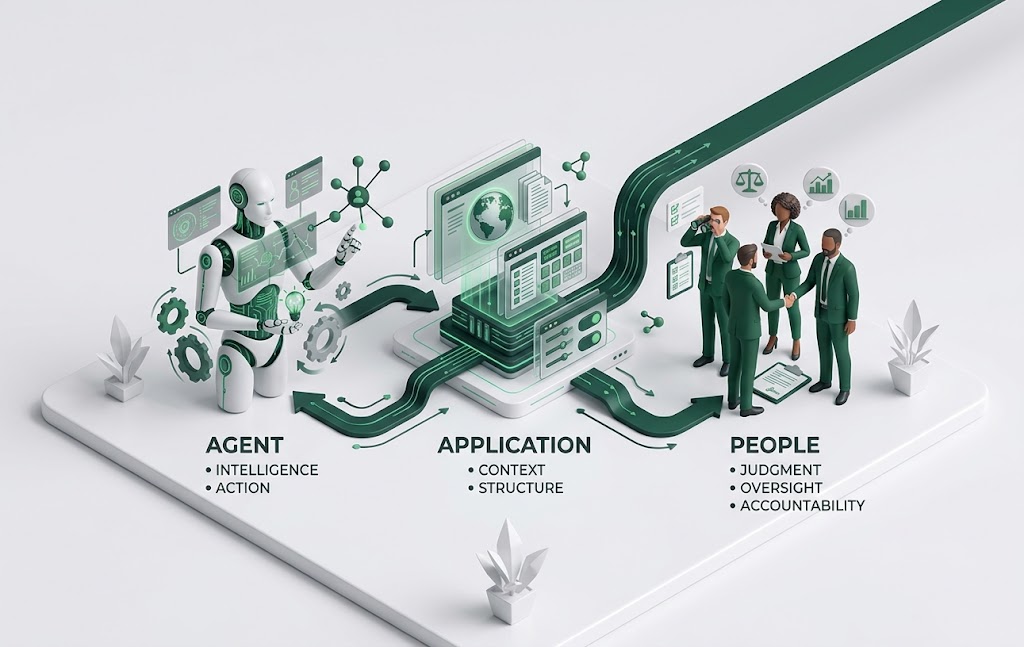
An agentic application brings AI agents together with the application infrastructure, workflows, and business processes needed to put those agents to work. [14]
The agent provides intelligence and action.
The application provides context, structure and control.
People provide judgment, oversight and accountability.
This is not simply a theoretical distinction.
Gartner‘s research points toward enterprise applications in which agents participate in workflows and collaborate with people rather than operating as isolated tools. [5]
Microsoft’s 2026 Work Trend Index makes a similar point from the workforce perspective. Its research found that as AI and agents take on more execution, people have more room to direct the work, make decisions and own the outcomes. The study surveyed 20,000 workers using AI across 10 countries and analyzed trillions of anonymized Microsoft 365 productivity signals. [7]
The implication is that agentic AI is not simply about giving an AI system more autonomy.
It is also about designing the environment in which that autonomy can be useful.
An agent might review information, classify a request, recommend an action or complete a task.
The application determines what information it can access, which systems it can interact with, what rules apply and when a person needs to become involved. [13]
That is much closer to how enterprise work actually happens.
The Enterprise AI Value Gap
The challenge is not simply getting AI into the organization. It is turning AI capabilities into repeatable business value.
McKinsey‘s research shows that most organizations are still in the early stages of scaling AI, despite widespread adoption. Only about one-third of respondents said their organizations had begun to scale AI programs across the enterprise. [3]
PwC’s 2026 Global CEO Survey found that only 12% of CEOs say AI has delivered both cost and revenue benefits, while 56% say they have seen no significant financial benefit from AI to date. The survey covered 4,454 CEOs across 95 countries and territories. [8]
The gap matters because enterprise value rarely comes from an AI model operating in isolation.
It comes when AI becomes part of how work gets done.
That means connecting AI capabilities to business applications, data, workflows, enterprise systems and people.
It also means putting the right boundaries around what AI can do.
Deloitte’s 2026 State of AI in the Enterprise report found that only one in five companies has a mature governance model for autonomous AI agents, even as agentic AI usage is expected to rise sharply over the next two years. [9]
Gartner has also warned that governance needs to account for differences in agent autonomy and scope. It predicts that by 2027, 40% of enterprises will demote or decommission autonomous AI agents because of governance gaps identified only after production incidents occur. [10]
The implication is straightforward: scaling agentic AI requires more than capable agents. It requires the environment around those agents to be designed for enterprise use.
__________________________________
“ By 2027, 40% of enterprises will demote or decommission autonomous AI agents because of governance gaps identified only after production incidents occur.”
Gartner
__________________________________
What Is an Enterprise Agentic AI Application Platform?
This is where a new platform category begins to take shape.
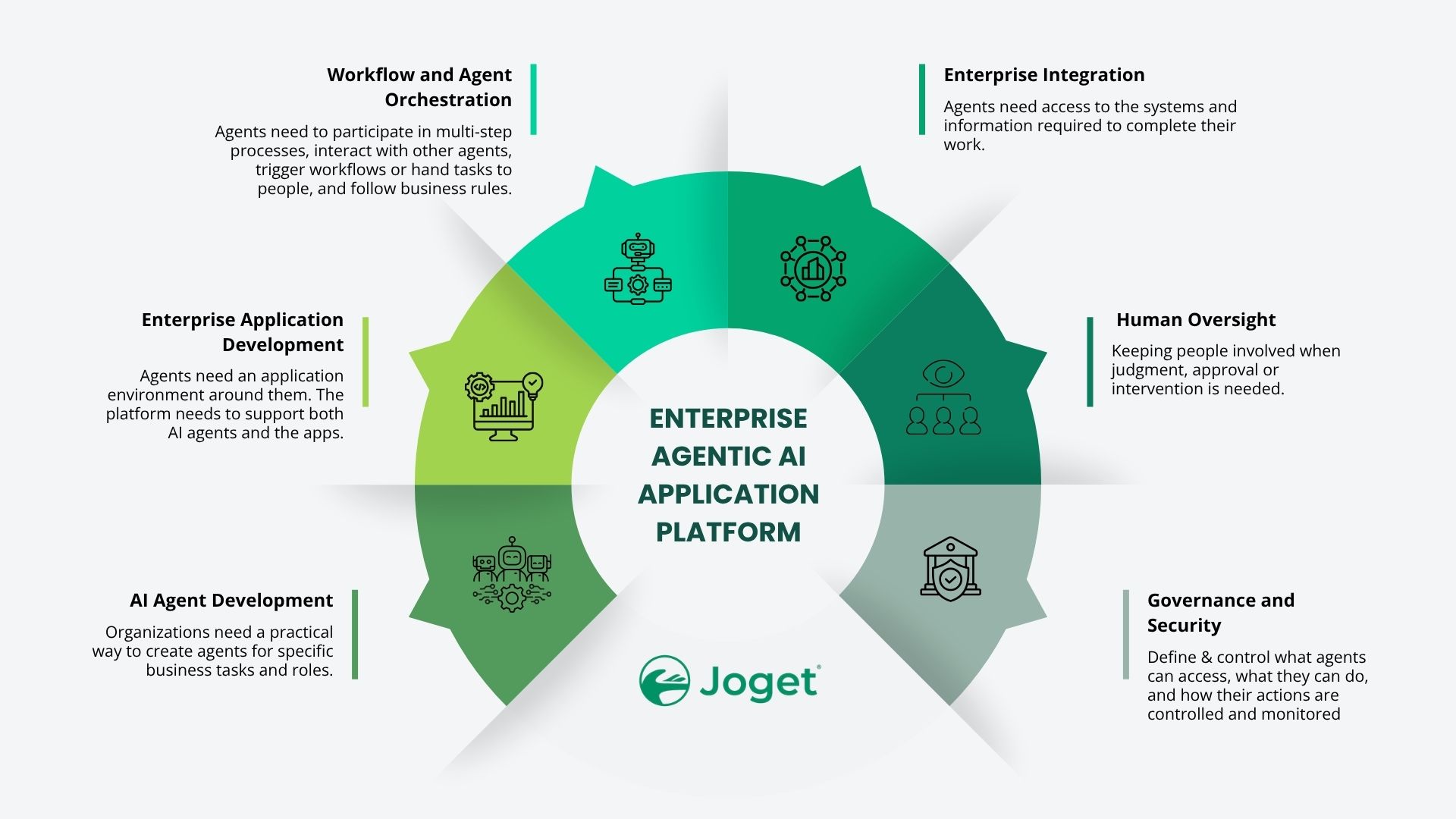
An Enterprise Agentic AI Application Platform brings together the capabilities needed to build applications in which AI agents and people can work together.
At a practical level, that means bringing together:
1. AI Agent Development
Organizations need a practical way to create agents for specific business tasks and roles.
This includes defining an agent’s purpose, capabilities, tools, knowledge, and level of autonomy, while making it possible to test and refine how it behaves before putting it into production.
2. Enterprise Application Development
Agents need an application environment around them.
Organizations still need forms, interfaces, business rules, data, permissions and other application components to support the people and processes involved.
The platform therefore needs to support both AI agents and the applications in which they operate.
3. Workflow and Agent Orchestration
In an enterprise environment, agents need to participate in multi-step processes, interact with other agents, trigger workflows or hand tasks to people, and follow business rules.
4. Enterprise Integration
Agents need access to the systems and information required to complete their work, including databases, APIs, enterprise applications and other business systems. [15]
5. Human Oversight
Some decisions can be automated. Others require review, approval or escalation. The platform needs to support those hand-offs as part of the process.
6. Governance and Security
As agents gain the ability to access information and take action, organizations need controls around what agents can access, what they can do, how they operate, and how their actions are monitored. [13]
These capabilities are increasingly reflected in how the industry describes agentic systems.
Gartner describes agentic AI as evolving from task- and application-specific agents toward broader agentic ecosystems, including multi-agent systems that can work across more complex workflows. [5]
IDC similarly highlights the need for organizations to establish guardrails around agent orchestration, workload, and data security as they deploy growing fleets of agents. [4]
The common thread is that the agent is only one part of the system.
Why This Matters to Enterprise Leaders
For enterprise leaders, the opportunity is bigger than finding another task that AI can automate. The real consideration is where AI can become part of the way the organization operates and creates value.
That requires looking beyond the agent itself. Business processes, applications, data, people, governance, security and technology architecture all become part of the conversation. These are the foundations that determine whether an AI capability can move from a promising pilot to something the organization can rely on at scale. [12]
Consider a customer service example. An AI agent might summarize a customer’s history or recommend the next action. That can save an employee time, but the impact is limited if the employee still has to search through different systems, update records and manage the rest of the process manually.
An agentic application could bring those steps together. It could retrieve customer records from enterprise systems, use the information to support a service workflow, recommend the next action, route the case to the right person and record what happened along the way. [16]
The business impact becomes more tangible. The organization can reduce manual work, shorten case handling times, reduce unnecessary hand-offs and give employees the information they need at the right point in the process.
At the same time, enterprise leaders have to consider what happens when AI moves beyond recommendations and starts taking action. An agent may have access to sensitive information, interact with business systems or trigger actions that have real operational consequences. Leaders need confidence that agents are operating within defined boundaries, that sensitive data is protected, that important decisions can be reviewed and that actions can be monitored and audited. [13]
This makes governance and security part of the foundation for scaling AI. The same applies to integration and architecture. If every AI initiative requires a separate set of controls and operating processes, scaling AI across the organization becomes increasingly difficult. [12]
This changes how organizations should think about AI investments. The goal is to create an environment where AI can become part of business processes in a way that delivers measurable improvements while remaining secure, governed and manageable at scale.
For enterprise leaders, that means looking at AI as part of the broader application and operating environment: how it connects to the work, how it creates business value, how people remain involved, and how the organization maintains control as AI takes on more responsibilityy.
Where Joget Fits
Joget is evolving toward this model with an open-source, enterprise Agentic AI application platform that brings no-code/low-code development and AI agents together to help organizations build and customize enterprise applications at scale.
Through Joget Intelligence, organizations can use Generative AI and Agentic AI capabilities to enhance and automate processes while keeping people involved through collaborative human workflows, with governance and oversight built into the environment.
With Vibe Composition, Joget also brings AI into application development. AI interprets business intent and assembles applications from pre-validated, governed components rather than generating raw code. This keeps applications visual, maintainable and governed while giving IT teams greater visibility and control.
AI agents can then operate within the applications and workflows where business work already happens. Joget AI Agent Builder allows agents to be configured visually and run within process workflows, where they can work alongside human participants and existing workflow controls.
This also extends to the boundaries around those agents. Joget provides guards that can check content before it reaches an LLMS and after the model responds, with rule-based, LLMS-based and webhook-based options.
Meanwhile the Agent Execution Audit Trail records agent runs and provides a node-by-node trace of requests, responses and status.
For enterprise integration, Joget connects applications with legacy and modern systems through its Application and Integration Fabric.
Together, these capabilities give organizations a way to bring AI agents, applications, workflows, people and enterprise systems together, while keeping governance, security and human oversight part of the environment in which they operate.
The goal is ultimately to give organizations the speed of AI with the control of visual development, providing a practical way to build intelligent enterprise applications that can be maintained, integrated and governed as they scale.
Where Agentic AI Goes Next
__________________________________
“ By 2028, 33% of enterprise software applications will include agentic AI capabilities”
Gartner
__________________________________
The next phase of enterprise AI will not be defined solely by how capable individual AI agents become.
It will also be defined by how well those agents fit into the organizations using them.
The shift is already underway. Gartner predicts that by 2028, 33% of enterprise software applications will include agentic AI capabilities, up from less than 1% in 2024. [11]
That points to a future where AI agents are increasingly part of the applications people use every day, rather than separate tools sitting alongside them.
But there is another important part of this shift: the role of people.
Microsoft’s 2026 Work Trend Index describes a future where agents take on more execution while people have more room to direct the work, make decisions and own the outcomes. [7]
That makes the future of enterprise applications less about choosing between people and AI, and more about creating a better way for both to work together.
An agent that can reason and act is useful.
An agent that can work with people, access the right systems, follow a business process, trigger actions, request approval and operate within clear governance is much closer to an enterprise capability.
This is why the conversation is moving from AI agents to agentic applications.
And from there, toward platforms that can bring together the full environment those applications need.
For enterprise leaders, the opportunity is to think beyond deploying another AI tool and start considering what the next generation of enterprise applications should look like.
- Applications where people remain in control of important decisions.
- Applications where AI agents can take on meaningful work.
- Applications where workflows, data and business systems are connected.
- And applications that can evolve as the organization does.
The future of enterprise applications will be about bringing people, AI agents, workflows, and enterprise systems together in the way work gets done.
That is where agentic AI goes next.
For more on the latest data around enterprise AI agent adoption, see our research: AI Agent Adoption in 2026: What the Analysts’ Data Shows.
Frequently Asked Questions
- What is an Enterprise Agentic AI Application Platform?
An Enterprise Agentic AI Application Platform is a platform for building applications that combine AI agents with enterprise data, workflows, business rules, integrations, and human oversight. It provides the application and governance foundation needed to deploy AI agents within real business processes securely and at scale.
- How is an Enterprise Agentic AI Application Platform different from an AI agent platform?
An AI agent platform primarily focuses on creating and running AI agents. An Enterprise Agentic AI Application Platform extends this by bringing agents together with applications, workflows, enterprise systems, data, people, security, and governance. This enables AI agents to operate within structured business processes rather than as standalone tools.
- What is an agentic application?
An agentic application is an enterprise application that uses AI agents to interpret information, make recommendations, or take actions within a defined business context. Unlike a standalone AI agent, an agentic application connects AI capabilities with application logic, workflows, data, enterprise systems, and human oversight.
- Why are AI agents not enough for enterprise applications?
AI agents provide intelligence and the ability to take action, but they do not automatically provide the business context, workflows, application logic, integrations, governance, or human oversight required by enterprise applications. Enterprises need these capabilities to ensure AI-driven actions are controlled, auditable, secure, and aligned with business processes.
- What capabilities should an Enterprise Agentic AI Application Platform include?
An Enterprise Agentic AI Application Platform should bring together AI agent development, enterprise application development, workflow and agent orchestration, enterprise integration, human oversight, and governance and security. These capabilities provide the foundation for embedding AI agents into real business processes and applications.
- Why are governance and human oversight important for enterprise AI agents?
Enterprise AI agents may access sensitive information, interact with business systems, and take actions on behalf of users or organizations. Governance and human oversight help define what agents can access and do, when human intervention is required, and how actions can be monitored and audited. This is essential for responsible enterprise adoption.
- How does Joget approach Enterprise Agentic AI Application Development?
Joget combines its open-source no-code/low-code application development capabilities with AI agents through Joget Intelligence. It enables organizations to visually build applications and agents, connect them to workflows and enterprise systems, and apply governance and human oversight. Vibe Composition also enables AI-assisted application development using pre-validated, composable components rather than generating raw code.
Sources
[1] McKinsey & Company, “AI at work but not at scale,” December 2025
[2] McKinsey & Company, “Building the foundations for agentic AI at scale,” April 2026
[3] McKinsey & Company, “The state of AI in 2025: Agents, innovation, and transformation,” November 2025
[4] IDC, “An IT tech leader’s guide through the agentic pivot,” November 2025
[5] Gartner, “Gartner Predicts 40% of Enterprise Apps Will Feature Task-Specific AI Agents by 2026” September 2025
[6] Gartner, “Gartner Predicts Over 40% of Agentic AI Projects Will Be Canceled by End of 2027” June 2025
[7] Microsoft, “2026 Work Trend Index: Agents, human agency, and opportunity,” May 2026
[8] PwC, “2026 Global CEO Survey,” January 2026
[9] Deloitte, “State of AI in the Enterprise 2026” January 2026
[10] Gartner, “Applying Uniform Governance Across AI Agents Will Lead to Enterprise AI Agent Failure,” May 2026
[11] Gartner, “3 Bold and Actionable Predictions for the Future of GenAI” December 2025
[12] Microsoft, “Agentic AI maturity model: AI governance and security,” May 2026
[13] Microsoft, “Govern and secure AI agents across the organization,” June 2026
[14] Deloitte, “Engineering the agentic enterprise,” January 2026
[15] NIST, “Announcing the AI Agent Standards Initiative for Interoperable and Secure Innovation,” February 2026
[16] McKinsey & Company, “Rewiring customer experience for the agentic era,” July 2026
Related
Last modified: October 7, 2026