A clear definition of low-code AI and five ways AI in low-code is changing how enterprises build software.
Low-code AI sounds like one product category, and it isn’t. The phrase gets used for platforms that help you build applications with AI, and also for tools that help you build AI with low-code. If you’ve been trying to work out which one you’re looking at, you’re in good company.
This post gives you a working definition and five specific ways AI is changing how enterprises build software. It closes with a short list for judging a low-code AI platform. Gartner now has its own name for the category, AI-augmented low-code application platforms (AILCAPs), and published its first Magic Quadrant under that name on September 28, 2026. [1]
You can read more about it in our guide to AI-augmented low-code.
What is low-code AI?
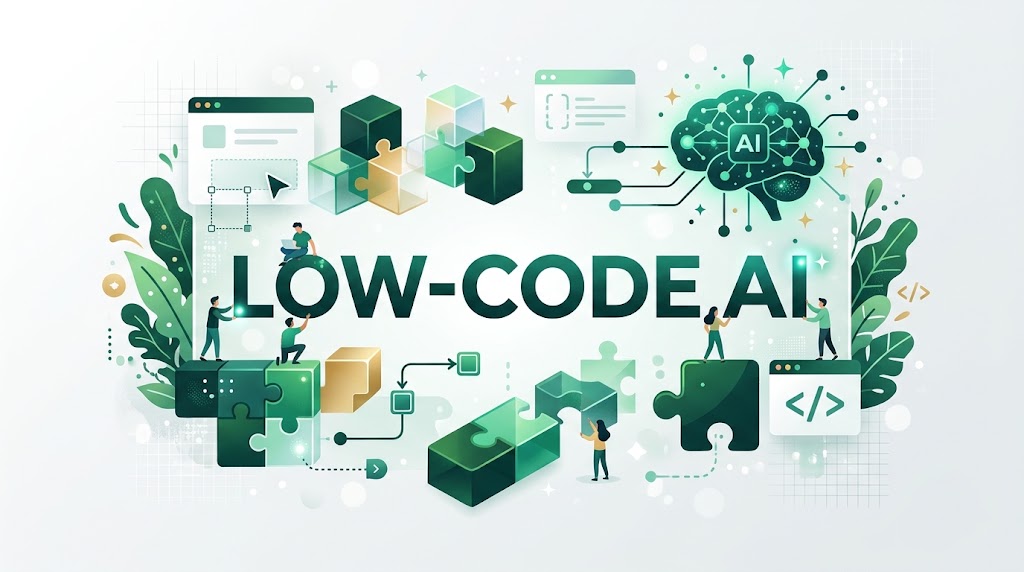
Low-code AI means two connected things: AI built into a low-code platform to help people create and run applications, and low-code tools used to build AI-powered applications and agents. The two meanings overlap, and a good low-code AI platform covers both.
In practice, a person describes an application in everyday language and the platform builds it from visual components that stay editable. AI agents can then take on steps inside the workflows that the application runs.
If low-code is new to you, here’s a quick definition for you. Low-code is an approach to building applications with visual tools and prebuilt components, with room for developers to add custom code when needed. AI changes how you get started and what the finished application can do.
Here’s how the two compare.
|
Traditional low-code |
Low-code AI |
| How an app starts |
A builder assembles screens and workflows using drag and drop |
A builder describes the app to AI, then edits what the platform generates |
| What the app can do |
Follows the rules and workflows you define |
Can also include agents that plan and carry out multistep work |
| Where developers spend time |
Building and editing components |
Reviewing generated work and extending it with code (if needed) |
| Governance |
Access control and change management |
The same access and management controls, plus oversight of AI sessions, model use, and agent runs |
Important things to note are that the visual builders don’t go away. AI gives people a faster way to use them.
How does AI change low-code development?
AI changes low-code development in five main ways: how apps start, what apps can do, who builds them, how risk is managed, and how quickly pilots reach production. Each one adds to the visual builders rather than replacing them.
1. Apps start with a conversation
AI lets a builder describe an application in everyday language and get a working first version to react to. Instead of placing every form and workflow step by hand, you start with something you can edit.
Forrester described a similar shift in May 2024 with what it calls application generation, or AppGen, platforms. [5] Gartner’s public abstract for its 2026 Magic Quadrant also lists AI generation among the capabilities that define these platforms. [1]
Joget’s AI Composer works this way. It turns a plain-language description into governed, auditable components that stay visible and editable in the visual builders, and teams can switch between conversational and manual editing at any point.
This is also where low-code AI differs from vibe coding. Vibe coding has an AI write source code your team must then review and maintain, while Joget’s Vibe Composition approach enables the assembly of applications from pre-validated components instead.
2. AI agents take on multistep work inside applications
An AI agent is software that plans and carries out multistep work across systems while people set goals and review results. Low-code platforms are adding visual ways to build agents, which puts them within reach of teams that don’t write agent code from scratch.
The adoption curve is steep. Gartner predicted in August 2025 that up to 40% of enterprise applications will include task-specific AI agents by 2026, up from less than 5% in 2025. [3]
Joget AI Agent Builder lets teams build agents visually, with human-in-the-loop review and approval. Agents work best when a person can still say yes or no before something important happens.
3. Business users and developers share the work differently
AI lowers the barrier to starting an application, so business users can get further on their own, while developers spend more of their time reviewing what gets built and extending it with custom code. Gartner’s abstract for its 2026 Magic Quadrant ties these platforms to faster app building for both developers and business users. [1]
The skills side is moving too. Gartner predicts that by 2029, at least half of knowledge workers will develop new skills to work with AI agents, including governing and creating them. [3]
If you lead IT, that’s less a threat to your team than a change in where their time goes. Joget is open source and can be extended with code, so developers keep a path to custom work.
4. Governance becomes part of how apps get built
With AI involved, governance has to cover the generated application and the agents running inside it, so it moves into the build process instead of arriving as a review at the end.
The stakes are visible in the numbers. Gartner predicted in June 2025 that more than 40% of agentic AI projects will be canceled by the end of 2027, with weak risk controls named among the causes. [4]
Joget AI Governance works at both design time and runtime. A governance console tracks each AI Composer session, including the app, the user, and token usage. Runtime guards check content before it reaches a model and after the model responds. Every agent run is recorded in an execution audit trail, and a usage dashboard shows token consumption by model.
5. AI pilots get a shorter route to production
A low-code AI platform gives teams a managed place to turn AI experiments into applications people can use, with access control and deployment already in place. The abstract of Gartner’s May 2026 research frames the move to AI-augmented platforms around closing the gap between AI pilots and production. [2]
Plenty of teams have a promising demo sitting somewhere. The hard part is the application around it: who can use it, what it connects to, and what happens when something goes wrong.
What should a low-code AI platform include?
A low-code AI platform should include visual builders, AI that generates editable components, a way to build agents, governance that covers the AI, and visibility into models and cost.
- Visual builders. AI output should land in components you can inspect and edit.
- AI-assisted app creation. You should be able to describe an application and get a working first version.
- Agent building with human review. Agents should be buildable visually, with approval steps for important actions.
- Governance that covers AI. Look for tracking of AI sessions, checks on content going to and from models, and an audit trail of agent runs.
- Model choice and cost visibility. You should know which models are in use and what they cost.
Ask any vendor to show these running in a live production environment, not on a roadmap slide.
Our AI-augmented low-code guide lists four questions to bring to that conversation. It also covers what Gartner calls “agent washing,” where vendors relabel existing chatbots and automation tools as agentic products. [4]
How does Joget approach low-code AI?
Joget is an open source platform that began as low-code workflow automation and is evolving into an agentic AI application platform. Its AI capabilities map to the five points above:
- AI Composer turns a plain-language description into governed, auditable components that stay editable in the visual builders.
- AI Agent Builder lets teams build agents visually, with human-in-the-loop review and approval.
- AI Governance adds a design-time console, runtime guards, an agent execution audit trail, and a usage dashboard.
- Vibe Composition, a modern AI-assisted app development approach where AI assembles applications from pre-validated components instead of raw generated code.
AI Composer and AI Agent Builder are part of Joget DX Enterprise Edition.
To see where agents are heading next, read From AI Agents to Enterprise Applications.
And if you’d like to see low-code AI working in practice, we’d be glad to walk you through it. Reach out to us.
Frequently asked questions about low-code AI
Frequently Asked Questions
What is low-code AI?

Low-code AI is the use of AI inside low-code platforms to help people build and run applications, along with the use of low-code tools to build AI-powered applications and agents. A strong platform covers both.
What is a low-code AI platform?
A low-code AI platform is a low-code platform with AI built into how applications are created and run. It typically includes visual builders, AI that generates editable components, tools for building agents, and governance for the AI involved. Gartner calls the category AI-augmented low-code application platforms. [1]
How is AI used in low-code?
AI is used in two main ways: generating applications from everyday-language descriptions, and powering agents that handle multistep work inside workflows. Governance features then track and control both.
Is low-code AI the same as AI-augmented low-code?
They describe the same idea at different levels. Low-code AI is the everyday term, and AI-augmented low-code application platforms (AILCAPs) is Gartner’s name for the market category. [1] Our AI-augmented low-code guide explains the category in detail.
Is low-code AI the same as vibe coding?
No. Vibe coding has an AI write source code from a prompt, and your team then reviews and maintains that code. Low-code AI applies AI inside a managed environment of governed components. Joget’s Vibe Composition takes the second approach, and Vibe Composition vs. Vibe Coding shows the two side by side.
Do you still need developers with low-code AI?
Yes, in our view. AI helps business users get further on their own, and developers still review what gets built and extend it with custom code where needed. Joget is open source and can be extended with code.
Can you build AI agents with low-code?
Yes. Low-code platforms are adding visual ways to build agents. With Joget’s AI Agent Builder, teams build agents visually, with human-in-the-loop review and approval. It is part of Joget DX Enterprise Edition.
Is Joget a low-code AI platform?
Yes. Joget is an open source low-code platform that began as workflow automation and is evolving into an agentic AI application platform. AI Composer and AI Agent Builder are part of Joget DX Enterprise Edition.
Sources
- Gartner, Magic Quadrant for AI-Augmented Low-Code Application Platforms (abstract), September 28, 2026: https://www.gartner.com/en/documents/8421913
- Gartner research, “The AI-Augmented Future of Low-Code Application Platforms (AILCAPs),” May 26, 2026 (full report requires a Gartner account; link opens the public abstract): https://www.gartner.com/en/documents/7909609
- Gartner press release, “Gartner Predicts 40% of Enterprise Apps Will Feature Task-Specific AI Agents by 2026, Up from Less Than 5% in 2025,” August 26, 2025: https://www.gartner.com/en/newsroom/press-releases/2025-08-26-gartner-predicts-40-percent-of-enterprise-apps-will-feature-task-specific-ai-agents-by-2026-up-from-less-than-5-percent-in-2025
- Gartner press release on agentic AI project cancellations and agent washing, June 25, 2025: https://www.gartner.com/en/newsroom/press-releases/2025-06-25-gartner-predicts-over-40-percent-of-agentic-ai-projects-will-be-canceled-by-end-of-2027
- Forrester, “The Rise Of Application Generation Platforms”: https://www.forrester.com/blogs/the-rise-of-application-generation-platforms
Joget resources
Related