Your guide to what low-code is, how it grew into enterprise low-code, and what Gartner’s new AI-Augmented Low-Code Application Platforms (AILCAPs) category means for IT leaders.
If you are choosing a platform for AI-enabled apps, the labels vendors use are changing fast, and a label alone will not tell you what a platform can do. Gartner has now given the low-code market its third name since 2017, and this one puts AI right in the title. [1] [2] [3] On 28 September 2026, it published its first Magic Quadrant for AI-Augmented Low-Code Application Platforms, or AILCAPs. [3] If low-code is new to you, it’s a way of building applications with visual tools and prebuilt components, with custom code where needed. AI-augmented low-code adds AI to how those applications are designed, built, and run.
One thing that may trip you up: Gartner’s Peer Insights market page still shows the earlier name as of October 2026, with a second line added: “Transitioning to AI-Augmented Low-Code Application Platforms.” [4] If you’ve seen both names floating around, that’s why.
Names aside, the fair question is what this means for the people choosing and running these platforms. This post walks through what low-code is, what a platform typically includes, how the category evolved, and where it might be headed, with clear answers along the way.
What is low-code?
Low-code is a way of building applications with visual tools and prebuilt components instead of writing most of the code from scratch, with room for developers to add custom code when needed. Gartner calls these platforms low-code application platforms, or LCAPs. [4] They’re commonly used for internal tools and for modernizing legacy systems. Forrester coined the term in 2014. [5] The idea is simple: spend less time on repetitive plumbing and more time on the problem you’re trying to solve.
No-code sits alongside it. No-code targets business users, often called citizen developers, who build without writing any code, while low-code keeps a path open for developers to extend what the platform generates. In practice, many platforms cover both ends.
If you lead IT, you’ve likely felt why this matters: demand for internal applications keeps outrunning what engineering teams can realistically build. Low-code gives teams a faster way in, and it gives IT a place to set standards for security, access, and change control, rather than finding out about a new tool after it’s already in use.
What are the key features of a low-code platform?
Most enterprise-grade low-code platforms share seven core building blocks, and Gartner’s own public definition of enterprise low-code points to a similar list. [4] In our experience, the difference between platforms usually shows up in how well these pieces work together.
Here’s what you’ll typically find:
- Visual development: drag-and-drop tools for interfaces, workflows, and data models.
- Prebuilt components: templates, connectors, and reusable elements that cut repetitive work.
- Integration: APIs and connectors that reach existing systems and data.
- Extensibility: the ability to add custom code where the visual tools stop.
- Deployment and runtime: hosting, scaling, and monitoring for the applications built.
- Governance and security: access control, audit trails, and version management.
- Collaboration: shared environments where business and IT teams build together.
How did low-code become enterprise low-code?
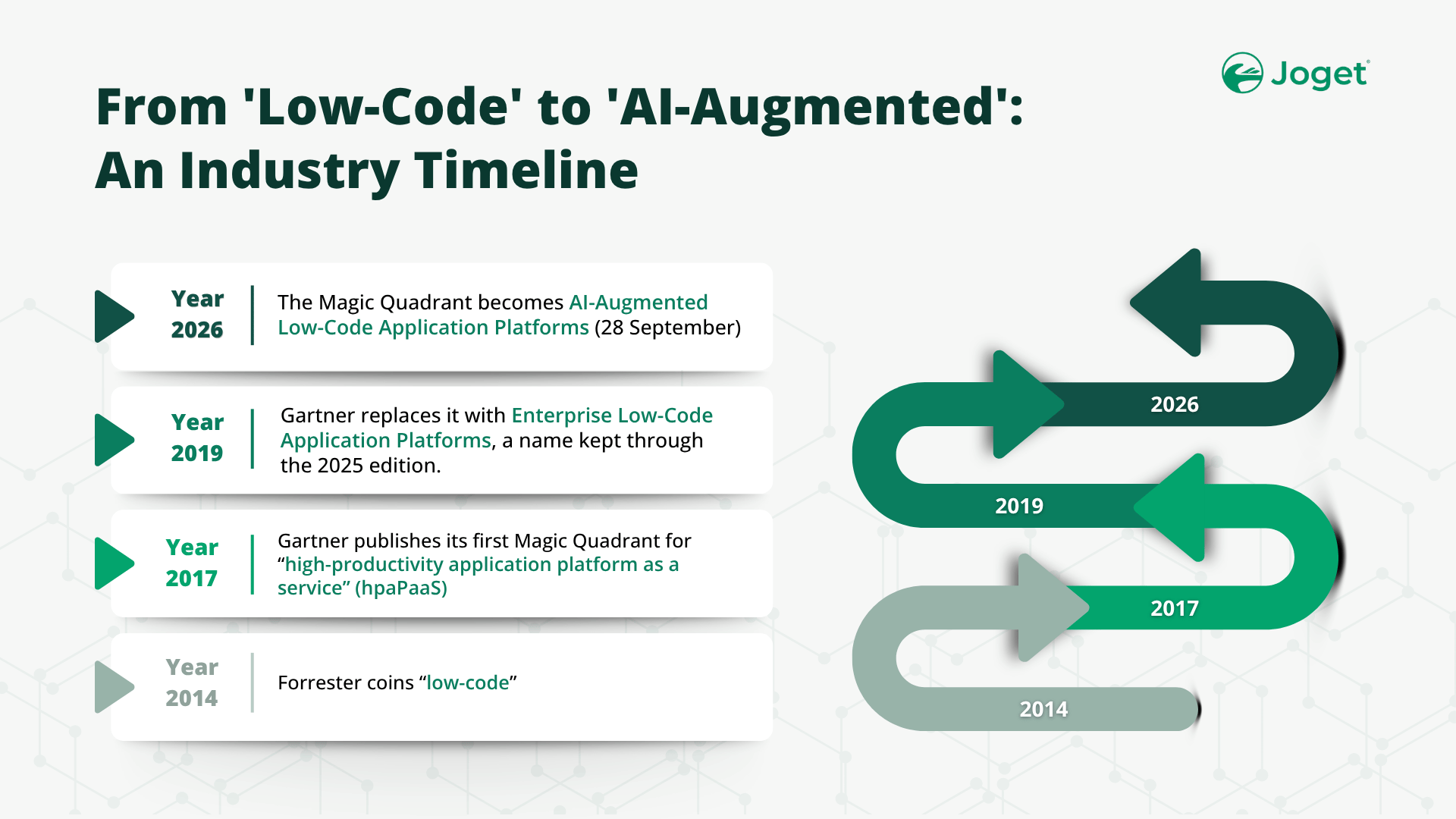
Low-code became enterprise low-code as platforms that began as departmental tools took on larger, more critical applications, and the market sorted into a few different types along the way. If all the renaming feels like churn, that’s fair, but the goal underneath has stayed consistent: getting useful software to the business faster.
Here’s the short history.
| Year |
What happened |
| 2014 |
Forrester coins “low-code”. [5] |
| 2017 |
Gartner publishes its first Magic Quadrant for “high-productivity application platform as a service” (hpaPaaS). [1] |
| 2019 |
Gartner replaces it with Enterprise Low-Code Application Platforms, a name kept through the 2025 edition. [2] [6] |
| 2026 |
The Magic Quadrant becomes AI-Augmented Low-Code Application Platforms (28 September). [3] |
The names have shifted as the market matured, so a new label isn’t a reason for alarm.
As for the platforms themselves, we’d group them into three broad kinds, though they overlap quite a bit, and most vendors sit somewhere between them. Please treat the examples below as illustrations, not a ranking.
Visual-first no-code/low-code platforms are built so business and IT teams can build side by side, with little or no hand-coding. Joget sits here today, as an open source platform that began as low-code workflow automation, can be extended with code when needed, and is evolving into an agentic AI application platform.
Model-driven low-code platforms center on modeling processes, data, and rules, often with a strong workflow focus. Appian is a common example.
High-performance low-code platforms target professional developers building complex, large-scale applications, with visual tooling alongside deep code-level control. OutSystems and Mendix are the names most people reach for here.
There are overlaps. Joget, for example, is workflow-centric like the model-driven group and also scales like the high-performance group: in Joget’s Telkom Indonesia case study, a Joget-based ticketing platform handles more than 1 million tickets a month on 150+ container pods. [11]
What is AI-augmented low-code?
In plain terms, AI-augmented low-code is low-code where AI is involved in how an application is designed, built, and run, with governance in place from the start. A chatbot added to an existing form builder doesn’t meet that bar.
It helps to remember how quickly this happened. Generative AI arrived, and instead of dragging components onto a canvas, a builder can now describe what they want in plain language and have the platform generate the screens and the underlying logic. The public abstract for Gartner’s 2026 Magic Quadrant ties these platforms to faster app building for both developers and business users, with AI generation, agentic workflows, and governance as the supporting pieces. [3] The abstract of its May 2026 research frames the move around closing the gap between AI pilots and production. [7]
In May 2024, Forrester described a similar shift with what it calls application generation (AppGen) platforms. [8] Two analyst firms reaching a similar place two years apart suggests the change is real, not just one vendor’s marketing angle.
How is vibe coding different from AI-augmented low-code?
Vibe coding and AI-augmented low-code both start from a plain-language prompt, but vibe coding has an AI write source code that your team then has to review and maintain, while AI-augmented low-code applies AI inside a managed environment of governed components. We see them as different tools for different jobs, and we’d rather you pick the right one than the trendiest one.
Joget’s Vibe Composition takes the second route and assembles applications from pre-validated components instead of raw generated code. For a side-by-side view, see Vibe Composition vs. Vibe Coding.
What comes after AI-augmented low-code?
In our view, agents come next: software that plans and carries out multistep work across systems, while people set goals, review results, and define guardrails. “Agentic AI low-code” is our shorthand, not an official category. Gartner’s May 2026 research treats the AI-augmented stage as one point in a longer progression and this suggests that the “low-code” label itself may eventually give way to broader AI-centric categories. [7]
In June 2025, Gartner predicted that more than 40 percent of agentic AI projects will be canceled by the end of 2027, citing escalating costs, unclear business value, and weak risk controls. [9] It also flagged “agent washing,” where vendors relabel existing RPA tools, chatbots, and assistants as agentic products without the capability to match. [9]
What should you ask a low-code vendor?
Four questions cut through the labels, whatever a platform calls itself. Each step in this evolution gives builders more speed and more freedom, and a higher cost if oversight slips, so they’re worth bringing to your next vendor conversation:
- Can the vendor show AI running in a live production environment, beyond a demo or roadmap slide?
- What governance is already built in, and what would you have to add yourself?
- If an agent makes a mistake, is there a rollback path and a named human owner?
- Where does your data go, which models can you choose, and what does a run cost?
How is Joget evolving into an agentic AI application platform?
Joget began as a low-code workflow automation platform well before the term low-code was first coined. Now Joget is evolving into an agentic AI application platform on an open source core: a platform where enterprises build and govern applications with agents involved, without giving up control. Joget is also listed in Gartner Peer Insights for this market, and its AI capabilities line up with the stages below. [4]
| Stage |
What Joget offers |
| Visual building |
Drag-and-drop builders for forms, workflows, data lists, and interfaces |
| AI-augmented |
AI Composer, which turns a plain-language description into governed and auditable components that stay visible and editable in the visual builders |
| Agents |
AI Agent Builder, for building agents visually with human-in-the-loop review and approval |
| Ready-made components |
Pre-built apps and plugins from the Joget Marketplace |
AI Composer is additive: the drag-and-drop builders are unchanged, and teams can switch between conversational and manual editing at any point. AI Composer and AI Agent Builder are part of Joget DX Enterprise Edition.
Governance runs across all of it, in three layers. At design time, a governance console tracks each AI Designer session, including the app, the user, and token usage. At runtime, guards check content before it reaches a model and after the model responds, and can block, sanitize, or redirect it. Every agent run is recorded in an execution audit trail, and a running agent can be stopped from the run detail view. For cost, a usage dashboard shows token consumption over time, broken down by model. More details on Joget’s AI governance.
That’s how Joget approaches the questions above:
- AI in production: AI Composer and AI Agent Builder are released in Joget DX Enterprise Edition, and we can show them running live.
- Governance: design-time tracking, runtime guards and audit trails, as described above.
- Rollback and a named owner: application versioning reverts a faulty application change. For agents, people stay in the loop so results can wait for human approval before they take effect. The audit trail records who started each agent run so each outcome traces to a named person.
- Data, models and cost: you choose the model provider, guards screen content before it reaches the model and after it responds, and the usage dashboard shows token use by model.
We cover the move to an agentic AI application platform in the blog post: From AI Agents to Enterprise Applications: Where Agentic AI Goes Next
The label will probably keep changing, and the questions worth asking will stay much the same. If you’re sorting through all this right now, we hope this recap makes the conversation a little easier. And if you’d like to see how any of it works in practice, we’d be glad to walk you through it. Reach out to us.
Frequently asked questions about low-code and AI-augmented low-code
What is low-code?
Low-code is an approach to building applications with visual tools and prebuilt components instead of writing most of the code by hand, while still letting developers add custom code when needed. Joget is an open source low-code platform built around that idea.
What’s the difference between low-code and no-code?
No-code is aimed at business users who build without writing any code, using visual tools alone. Low-code also uses visual tools, but it keeps a path open for developers to add custom code where the visual tools stop. Many platforms, including Joget, cover both ends.
What are the benefits and limitations of low-code?
Low-code typically speeds up delivery and brings business and IT closer together, and it gives IT one place to apply security and governance standards. Very specialized logic can still need custom code, so test a platform on a real project before you commit. Joget is open source and can be extended with code and ready-made apps and plugins.
What does “AI-augmented low-code” mean?
In plain terms, an AI-augmented platform has AI involved in how an application is designed, built, and run, with governance in place from the start. A chatbot added to an existing form builder doesn’t meet that bar. Gartner’s public abstract for its 2026 Magic Quadrant ties these platforms to faster app building through AI generation, agentic workflows, and governance. [3] Its May 2026 research abstract uses the shorthand AILCAPs and frames the shift around closing the gap between AI pilots and production. [7]
How is AI-augmented low-code different from traditional low-code?
Traditional low-code centers on visual modeling: builders drag and drop components to assemble screens, workflows, and data models. AI-augmented low-code keeps those tools and lets a builder describe what they want in plain language and review what the platform generates.
Joget’s AI Composer works this way: you describe an application in plain language, and it builds standard Joget components that stay editable in the visual builders.
Has Gartner officially renamed the enterprise low-code category?
Yes, in its research. On 28 September 2026, Gartner published the Magic Quadrant for AI-Augmented Low-Code Application Platforms and its Critical Capabilities, following the 2025 edition titled Enterprise Low-Code Application Platforms. [3] [6] [10] Gartner’s Peer Insights market page still shows the earlier name with “Transitioning to AI-Augmented Low-Code Application Platforms” alongside it. [4]
What is the Gartner Magic Quadrant for AI-Augmented Low-Code Application Platforms?
It’s Gartner’s vendor evaluation for this market, published on 28 September 2026 and the first Magic Quadrant under the AI-Augmented name. According to its public abstract, it assesses vendors on their platforms’ AI capabilities, execution, and vision. [3] A companion Critical Capabilities report was published the same day. [10] The full reports require a Gartner account.
Will AI replace low-code?
In our view, AI is changing low-code more than replacing it. Vibe coding, where an AI generates source code from a prompt, is fast for prototypes, while low-code platforms provide governed components, access control, and deployment in one managed environment. That’s why the category is moving toward AI-augmented platforms, where AI helps build inside that environment.
Gartner’s May 2026 research even suggests the “low-code” label may eventually give way to broader AI-centric categories, so the label may change before the need for governance does. [7] Joget’s Vibe Composition assembles applications from pre-validated, governed components instead of generating raw source code.
Can you build AI agents with low-code?
Yes. Low-code platforms are adding agent capabilities so teams can build AI agents visually instead of writing them from scratch. With Joget’s AI Agent Builder, teams build agents visually, with human-in-the-loop review and approval. AI Agent Builder is part of Joget DX Enterprise Edition.
What should I ask a vendor before trusting an “AI-augmented” label?
Ask whether they can show AI running in a live production environment, what governance is already built in, what the rollback path and named human owner are when an agent makes a mistake, and where your data goes, which models you can choose, and what a run costs.
These questions matter because Gartner has warned about “agent washing,” where vendors relabel existing RPA tools, chatbots, and assistants as agentic products without the capability to match, and it predicts that more than 40 percent of agentic AI projects will be canceled by the end of 2027. [9]
Is Joget a low-code platform?
Yes. Joget began as a low-code workflow automation platform, and low-code is still its foundation: teams build applications with visual builders and extend them with code when needed.
Today Joget is evolving into an AI-augmented, agentic AI application platform, with AI capabilities added alongside those builders.
Is Joget open source?
Yes. Joget is an open source platform. Joget DX Enterprise Edition adds AI capabilities such as AI Composer and AI Agent Builder.
Does Joget offer AI-augmented low-code capabilities?
Yes. Joget is listed in Gartner Peer Insights for this market, and it’s evolving into an agentic AI application platform. [4] AI Composer lets teams describe an application in plain language and get standard Joget components that stay editable in the visual builders. AI Agent Builder lets teams build agents visually, with human-in-the-loop review and approval. Both are part of Joget DX Enterprise Edition.
How does Joget govern AI agents?
Joget AI Governance runs in three layers. At design time, a governance console tracks each AI Designer session. At runtime, guards check content before it reaches a model and after the model responds, and every agent run is recorded in an execution audit trail. For cost, a usage dashboard shows token consumption over time, broken down by model.
Sources
- Solutions Review, on Gartner’s first hpaPaaS Magic Quadrant, 2017: https://solutionsreview.com/cloud-platforms/a-look-at-gartners-2017-magic-quadrant-for-enterprise-high-productivity-application-paas/
- Solutions Review, on Gartner’s 2019 Magic Quadrant replacing the hpaPaaS one: https://solutionsreview.com/application-development/whats-changed-2019-gartner-magic-quadrant-for-enterprise-low-code-application-platforms/
- Gartner, Magic Quadrant for AI-Augmented Low-Code Application Platforms (abstract), 28 September 2026: https://www.gartner.com/en/documents/8421913
- Gartner Peer Insights market page, category transition and public definition: https://www.gartner.com/reviews/market/enterprise-low-code-application-platform
- Springer, “Low-Code Platform” (Forrester coined the term in 2014): https://link.springer.com/article/10.1007/s12599-021-00726-8
- Gartner, Magic Quadrant for Enterprise Low-Code Application Platforms (abstract), 28 July 2025: https://www.gartner.com/en/documents/6773234
- Gartner research, “The AI-Augmented Future of Low-Code Application Platforms (AILCAPs),” Adrian Leow, May 26, 2026 (full report requires a Gartner account; link opens the public abstract): https://www.gartner.com/en/documents/7909609
- Forrester, “The Rise Of Application Generation Platforms”: https://www.forrester.com/blogs/the-rise-of-application-generation-platforms
- Gartner press release on agentic AI cancellations and agent washing, June 25, 2025: https://www.gartner.com/en/newsroom/press-releases/2025-06-25-gartner-predicts-over-40-percent-of-agentic-ai-projects-will-be-canceled-by-end-of-2027
- Gartner, Critical Capabilities for AI-Augmented Low-Code Application Platforms (abstract), 28 September 2026: https://www.gartner.com/en/documents/8433713
- Joget customer story, Telkom Indonesia ticketing platform: https://joget.com/customer-stories/telkom-indonesia-legacy-system-modernisation/
Joget resources
Related
Last modified: October 28, 2026