What is Vibe Coding, its enterprise risks, and how does Vibe Composition offer a secure solution?
Vibe coding is a form of software development that uses artificial intelligence (AI) to turn natural language into computer code, representing a fundamental shift from traditional line-by-line coding. While it accelerates development, raw AI-generated code introduces significant enterprise risks like security vulnerabilities and technical debt. Joget's Vibe Composition offers a secure solution by assembling applications from trusted, governed, and composable components, rather than relying on fragile code predictions, ensuring enterprise-grade governance and scalability.
Formally put, vibe coding is a form of software development that involves turning natural language into computer code by using artificial intelligence (AI). It represents a fundamental shift from traditional development approaches, where developers write explicit instructions line by line.
What Vibe Coding Really Is
Coined by AI pioneer Andrej Karpathy in February 2025, vibe coding isn’t about typing less. It’s about thinking differently. Instead of writing line-by-line code, you:
- Describe intent in plain language (e.g., “Build a customer feedback dashboard that flags urgent issues”).
- Let AI handle implementation, debugging, and refinement—often without reviewing the raw code.
- Stay in flow state by offloading cognitive load to agentic AI tools.
As Karpathy put it: “I just talk to [Cursor] Composer with SuperWhisper, so I barely even touch the keyboard. I ‘Accept All’ always. I don’t read the diffs anymore. When I get error messages, I just copy-paste them in with no comment. That’s vibe coding.”
Developers prompt with intent in vibe coding by describing their desired application functionality in plain language. For example, they might prompt: 'Create a customer feedback form that routes urgent issues to Slack.'
How Vibe Coding Works (Step by Step)
How do developers prompt with intent in vibe coding?
Example: Create a customer feedback form that routes urgent issues to Slack.
How do AI tools generate code in vibe coding?
AI tools (Cursor, GitHub Copilot, Replit) output a first draft. Vibe coders often “Accept All” without reviewing every line.
How is debugging handled with AI in vibe coding?
Hit an error? Paste the log back into the AI prompt with no extra context. The AI “solves” it iteratively.
How is the AI-generated output refined in vibe coding?
“Make the UI more mobile-friendly.” AI tweaks the output. Repeat until it feels right.
Why Enterprises Are Paying Attention
Gartner predicts in its research report, ‘Why Vibe Coding Needs to Be Taken Seriously,’ that by 2028, 40% of new enterprise production software will be created with vibe coding techniques and tools.
Why the rush?
- Speed: Prototype complex features in hours, not weeks.
- Cognitive relief: Developers focus on what to build, not how.
- Innovation velocity: Test bold ideas without upfront architectural debt.
No wonder industry analysts project rapid adoption for non-critical workflows. When you’re racing to validate an idea, vibe coding feels like rocket fuel.
By 2028, 40% of new enterprise production software will be created with vibe coding techniques and tools.
— Gartner
What is the bottom line on vibe coding for enterprise applications?
But here’s what the hype won’t tell you: Vibe coding isn’t ready for mission-critical systems.
Why?
Security blind spots
- AI-generated code often bypasses security reviews, embedding vulnerabilities.
Hallucination debt
- As we note in our recent article and whitepaper – Beyond AI Code Generation: Why Composition, Not Code, Is the Future: “LLMs don’t ‘know’ code—they predict tokens. When predictions fail, they don’t produce minor bugs. They produce hallucinations.”
- Unlike human errors, AI hallucinations are systemic and hard to trace. Fixing them requires deep expertise after the damage is done.
Debugging nightmares
- When AI “solves” errors by pasting logs back into prompts, you get working code, but zero understanding of why it works.
Maintenance debt
- Unstructured, AI-spun code becomes a black box. Updating it? Like rewiring a house in the dark.
Enterprise reality check
- Business systems managing millions of transactions, sensitive data, and compliance requirements can’t risk probabilistic code generation. What works for side projects becomes unacceptable risk at enterprise scale.
Scalability traps
- Try building a distributed banking app with vibe coding. You’ll hit walls in performance tuning and compliance.

The Next Step: Why Composition Beats Raw Code
Vibe coding revealed a truth: Developers shouldn’t drown in syntax. But enterprises can’t trade security for speed.
This is where the industry is quietly pivoting. For mission-critical apps, raw AI code generation—no matter how “vibey”—isn’t enough.
What enterprises need is application composition, or as we call it at Joget, Vibe Composition.
“The future isn’t about AI replacing developers with black-box code. It’s about rapidly assembling trusted, governed, and composable components into robust applications focusing on security, scalability, and long-term maintainability.”
— Julian Khoo, Chief Technology Officer, Joget Inc
Vibe Composition sits between raw vibe coding and rigid AI coding. It keeps the intuitive, intent-driven flow developers love, but adds critical guardrails for enterprises:
✅ You stay in control:
AI suggests components, but you review and approve every connection and data flow before deployment.
✅ Built for business requirements:
Components are continuously monitored and validated through the Governance Hub to ensure security standards and compliance requirements are met.
✅ Transparent architecture:
Every AI-suggested component is mapped visually. No black boxes. No hidden debt.
✅ Smooth transitions:
Move applications from testing to production environments with consistent deployment processes and built-in quality checks.
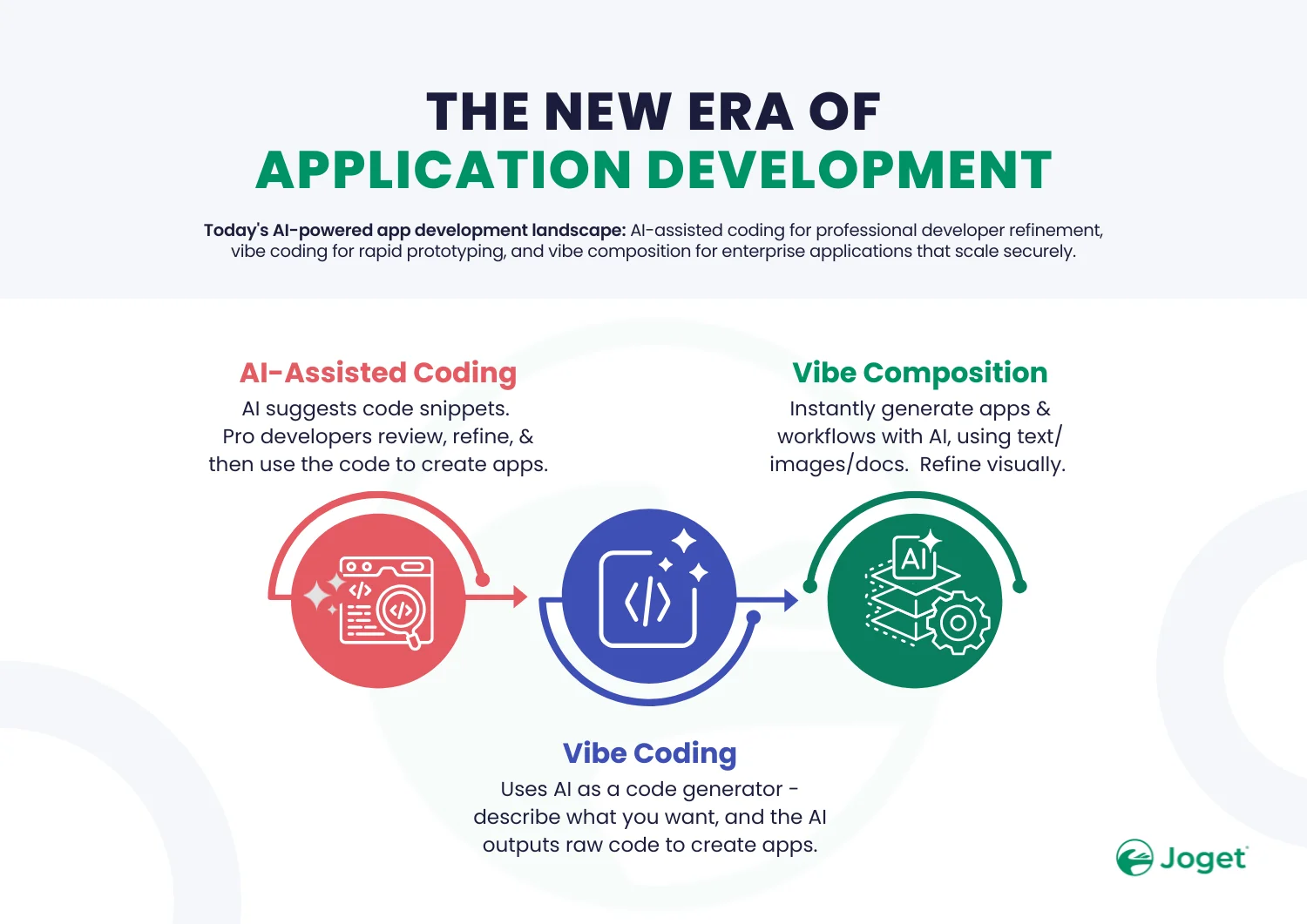
Platforms like Joget make this shift practical today, not by generating raw code, but by assembling apps from trusted, governed, and composable components that ship faster without sacrificing control.
These aren’t theoretical concepts; they’re mission-critical applications running in production right now. Joget DX leverages AI through its AI Designer to intelligently accelerate the assembly of business-ready components—forms, workflows, APIs, and UI elements—transforming natural language descriptions, documents, or visual mockups into fully functional enterprise applications.
The result? Applications that scale to tens of millions of transactions per month while maintaining enterprise-grade reliability. This isn’t about replacing developers with AI; it’s about empowering teams to build resilient systems that thrive under real-world demands. Composition isn’t just the spark; it’s the fire that transforms how enterprises build software.
The Bottom Line
Vibe coding isn’t magic. It’s a powerful prototyping tool that excels when constraints are clear and risks are contained. But for enterprises running payroll systems, healthcare apps, or financial platforms? Raw AI code generation is a shortcut that often backfires.
The future belongs to secure composition, where human intent meets enterprise-grade governance. And that future is already here.
_________
In our next post, we’ll dive deeper into how Vibe Composition transforms enterprise application development—turning the promise of AI into a governed, scalable reality.
Ready to build AI-powered apps without the hallucination risk?
➡️See how Joget’s open-source AI-powered platform turns intent into secure enterprise apps – www.joget.com/dx9
➡️ Read: “Beyond AI Code Generation: Why Composition, Not Code, Is the Future” https://joget.com/beyond-ai-code-generation-why-composition-not-code-is-the-future/
Build with intent. Deploy with certainty.
Vibe Coding FAQ: Answers to Your Top Questions
What is vibe coding?
Vibe coding is a form of software development that uses artificial intelligence to turn natural language descriptions into working code. Instead of writing line-by-line instructions, developers describe what they want to build in plain language, and AI tools handle implementation details. The approach was coined by AI pioneer Andrej Karpathy in February 2025.
How does vibe coding actually work?
Vibe coding works through a conversational workflow: 1) You describe your application needs in plain language, 2) AI tools generate initial code, 3) When errors occur, you paste them back into the AI prompt without additional context, and 4) You refine the output through continued conversation until it meets requirements. Popular tools include Cursor, GitHub Copilot, and Replit.
Why is it called “vibe” coding?
The term comes from the developer’s focus on maintaining a creative “flow state” or “vibe” rather than getting bogged down in syntax details. As Karpathy described it, developers “fully give in to the vibes” by trusting AI to handle implementation details and solve problems without manual code review.
Is vibe coding the same as AI coding?
Vibe coding is a specific approach within AI-assisted development. While traditional AI coding tools suggest code snippets or complete lines, vibe coding takes a more agentic approach where developers rarely review the actual code, focusing instead on describing desired outcomes and accepting AI-generated solutions.
What are the benefits of vibe coding?
Vibe coding dramatically accelerates prototyping, reduces cognitive load for developers, and democratizes app creation by allowing non-technical team members to contribute via natural language. Startups and innovation teams can validate ideas in hours rather than weeks, making it ideal for early-stage development and proof-of-concept work.
What are the hidden risks of vibe coding?
The primary risks include security vulnerabilities from bypassed code reviews, “hallucination debt” when AI predicts incorrect code patterns, debugging challenges due to a lack of understanding of the underlying logic, maintenance difficulties with unstructured code, and scalability limitations for complex enterprise systems.
Can enterprises use vibe coding for production applications?
Industry analysts recommend limiting vibe coding to sandboxed prototyping environments. For mission-critical systems handling sensitive data or high transaction volumes, raw AI-generated code presents unacceptable security and reliability risks without proper governance guardrails.
How is Vibe Composition different from vibe coding?
Vibe Composition maintains the intuitive, natural language interface of vibe coding but replaces fragile AI-generated code with pre-vetted, governed components. Instead of hallucinating raw code, AI assists in assembling secure building blocks (forms, workflows, APIs) that follow enterprise compliance requirements and can scale to production demands.
What tools support vibe coding today?
Popular vibe coding tools include Cursor (especially with its Composer feature), GitHub Copilot, Replit, and emerging platforms like Loveable. These tools vary in their capabilities for understanding context and maintaining coherence across large codebases.
Is vibe coding just a trend or here to stay?
While the term “vibe coding” gained prominence in 2025, the underlying approach reflects a fundamental shift in developer-AI collaboration. The methodology will likely evolve toward hybrid models like Vibe Composition that balance speed with governance, especially for enterprise applications. Gartner predicts 40% of new enterprise software will incorporate these techniques by 2028.
When should I use vibe coding versus traditional development?
Use vibe coding for rapid prototyping, proof-of-concept work, and non-critical applications where speed outweighs maintenance concerns.
Stick to traditional development or Vibe Composition approaches for systems requiring security compliance, high reliability, complex integrations, or long-term maintainability.
How can enterprises safely adopt vibe coding techniques?
Enterprises should use Vibe Composition rather than raw vibe coding, enabling them to generate applications instantly and securely with natural language prompts rather than fragile AI-generated code.
For teams still exploring traditional vibe coding approaches, safety requires:
- Confining experiments to development sandboxes,
- Implementing mandatory security scanning of all AI-generated code
- Using platforms that generate visual, composable components rather than raw code, and
- Establishing clear governance policies about which systems can incorporate AI-generated elements.
The most forward-thinking enterprises are skipping the risk phase entirely by building on composition-native platforms from day one.
Get Started with Joget: Experience Vibe Composition
Get started and start building your own enterprise app with Joget DX now.
AI-powered automation that accelerates productivity.
Watch the quick overview and learn from the video tutorials.
Grow your Joget knowledge with the tutorials, sample apps, and other documentation references.
Ask questions, get answers, and help others.
Contribute to Joget Translations in more than 20 languages.
Learn online and get certified.
Download ready-made apps, plugins, templates, and more.
Get the latest insights on the Joget platform.
Last modified: June 17, 2026


Latest Articles
September 4, 2026 | Joget, Inc.
Lesotho Launches National Farmers Portal, Giving Every Farmer a Place in a Single Digital Registry
The new registration system, built on Joget DX Enterprise, brings farmer and land information together across all 10 districts, giving…
ReadSeptember 3, 2026 | Joget, Inc.
Joget Introduces Agent Lab, a Program Helping Businesses Build AI Agents Without Code
New community initiative invites businesses to submit real workflow challenges for a free, expert-built AI agent, with selected builds shown…
ReadAugust 13, 2026 | Joget, Inc.
