
Businesses are moving fast to stay ahead in the digital world, and low-code platforms are making it easier than ever to build and scale applications. By simplifying app development, these platforms save time, cut costs, and open the door for more people—not just developers—to create powerful solutions. This means businesses can move quickly, adapt to new challenges, and bring ideas to life without the usual development roadblocks.
But what’s next for low-code? Is it just a passing trend, or is it here to stay? And how are businesses actually using it today? Gartner, predicts that by 2025, 70% of new applications developed by organizations will utilize low-code or no-code technologies, a significant increase from less than 25% in 2020.
These numbers make one thing clear: low-code isn’t just gaining momentum—it’s reshaping the future of software development.
To see just how impactful low-code has become, let’s explore some key statistics that highlight its growing influence.
Low-Code Market Growth
The low-code development platform market is expected to grow substantially during the forecast period (2024 to 2034), fueled by the rising need for faster and more affordable application development solutions.
- $36.43 Billion by 2027: ReportLinker projects that the global low-code market will reach $36.43 billion by 2027
- 21% Annual Growth: Forrester predicts a 21% annual growth rate, with the market reaching $30 billion by 2028.
- 26.1% CAGR Growth: Grand View Research estimates the Asia Pacific low-code market will grow at a compound annual growth rate (CAGR) of 26.1%.
- Fastest Growth in Services: Forrester forecasts the services segment will experience the most rapid growth from 2024 to 2034.
- The North American region: Precedence Research predicts the North American region to dominate the global low-code market during this period (2024 to 2034).
- 450 Million of 500 Million Apps: Microsoft expects, that out of 500 million apps expected to be developed in the next five years, 450 million will utilize no-code and low-code platforms.
Research and Market attributes this growth to a global shortage of developers, increased demand for agile app creation, and ongoing digital transformation efforts.
With advancements in AI and cloud technology, businesses are leveraging low-code to cut costs, speed up deployment, and manage more complex applications efficiently.
Low-Code Market Growth – Statistics by Gartner
Gartner’s valuable insights into its rapid expansion highlight the impressive growth of the low-code market:

- Low-Code Application Platform (LCAP) Growth: The LCAP market is projected to reach $16.5 billion by 2027, growing at a compound annual growth rate (CAGR) of 16.3% from 2022 to 2027. This expansion signals significant opportunities for both established vendors and emerging players.
- Overall Low-Code Development Technologies Market: The broader low-code development technologies market is expected to grow to $44.5 billion by 2026, with a CAGR of 19%. Beyond this, related services like consulting and outsourcing could represent an additional market opportunity valued between $69 billion and $92 billion.
- Non-IT Adoption: Gartner predicts that by 2026, 80% of low-code users will come from non-IT departments.

Low-Code Adoption Trends
- Low-code adoption is surging across industries, with financial services, healthcare, and manufacturing leading the charge.
- Nearly 60% of custom apps are now developed outside IT departments, with 40% of these users coming from professional roles.
- By the end of 2025, half of the new low-code users will be business buyers outside the IT organizations.
Why Low Code Matters
- Low-code platforms can speed up software development 10 times faster than traditional methods.
- Low-code can reduce development time by 50%-90% compared to traditional coding.
- Companies using low-code platforms often see faster time to market, with apps built and deployed in under 3 months.
- In a global survey on low-code development speed, 29% of respondents said low-code is 40-60% faster than traditional methods, while another 29% reported speeds of 61-100% faster.

- KPMG’s 2022 survey of 715 companies across Europe, the Middle East, and Africa highlights the growing importance of low-code development. Around 60% of company managers consider it “critical to very critical” for their business operations and strategy.
This study explores key insights, industry trends, and success factors shaping the future of low-code development. Here are some of the numbers:
- 44% report increased process efficiency.
- 39% experienced improved employee productivity.
- 36% achieve notable cost reduction.
- 33% see high flexibility, scalability, and greater automation.
- 30% benefit from enhanced service/product quality, faster time to solutions, and digital skills.
- 29% enjoy shorter release cycles.
26% expand their product/service portfolios.

Low Code Use Case
KPMG’s research highlights the growing adoption of low-code across various business functions. When asked about their planned areas for low-code deployment, respondents reported:
- CRM (42%)
- E-commerce/Sales & Marketing (42%)
- HR (39%)
- Customer Portals (37%)
- Customer Services (36%)
- Supply Chain (36%)
- Data Analytics (35%)
- ERP (34%)
- Industry 4.0/IoT (30%)
What are the Benefits of Low-Code Automation
While general low-code/no-code platforms simplify app development, low-code workflow automation focuses on streamlining and automating workflows like approvals and data handling. With drag-and-drop interfaces, templates, and reusable components, these tools make process automation both efficient and accessible.
Notably, 70% of users without coding experience mastered these tools within a month, thanks to their simplicity and quick deployment.
-
Reduced Development Time and Cost
According to a global survey conducted by Statista, 29% of respondents reported that low-code development is 40–60% faster compared to traditional development methods.
By streamlining the development process, low-code platforms boost productivity, enabling teams to focus on higher-value tasks. According to the Reveal survey, they improve developer productivity in 9 out of 10 organizations.
Low-code platforms enable organizations to quickly adapt to market changes and evolving business needs, enhancing their agility. 43% of firms using low-code development stated that they were more agile than before.
Challenges in Low-Code Adoption
While low-code offers plenty of advantages, it’s not without its hurdles. Here are some common challenges businesses face:
- Only 5% of reviews describe low-code platforms as “clunky.” Other concerns include vendor lock-in (37%), scalability (28%), security (25%), and a lack of expertise (43%).
- Only 12% of enterprises manage their business processes using low-code tools after buying them.
- According to KPMG research, the top three challenges cited by company managers when using low-code development are:
| Business Managers |
IT Managers |
| Too complex to maintain/implement: 41% |
Lack of management and employee transparency: 41% |
| Lack of customization options: 40% |
Too complex to maintain/implement: 43% |
| Lack of employee and management acceptance: 39% |
Shadow IT: 42% |
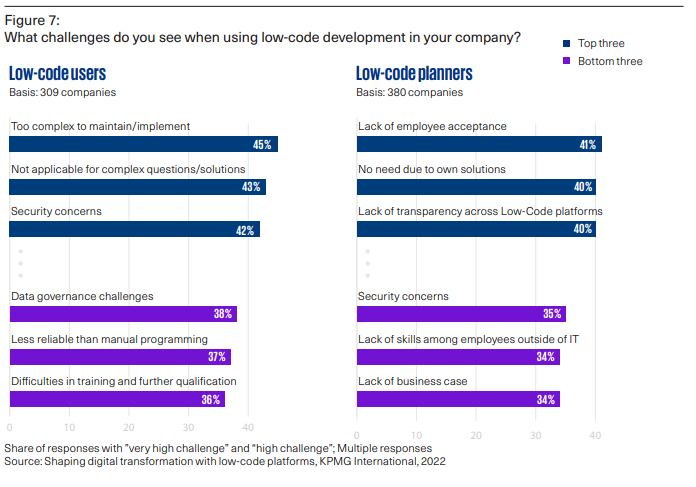
Image Source
Final Thoughts
Low-code development is no longer just an emerging trend—it’s a game-changer for businesses looking to innovate and stay ahead. It’s not about keeping up anymore; it’s about leading the way. If building apps faster and streamlining processes is a priority, low-code is the answer.
But success with low-code isn’t just about technology—it’s about people. Equipping teams with the right mindset and skills is just as important as the platform itself. And with AI-powered low-code solutions gaining traction, the possibilities are only expanding.
By understanding industry trends and adoption strategies, businesses can make informed decisions to integrate low-code effectively—turning potential into real impact.
Explore These Low-Code Resources:

What’s Next in App Development: Trends for 2025
Read Article
Related