
According to Forrester’s April 2021 report Forget About Build Versus Buy; Your Choice Is Customize Or Compose, the traditional mentality of acquiring software using an exclusive build or buy approach is no longer relevant. Buying packaged software rarely fits out-of-the-box and almost always requires customization and integration, so the complexity and cost are often underestimated. On the other hand, building customized software from scratch is definitely a very expensive proposition typically fraught with high rates of project failure.
Digitization and software allow businesses to be adaptive, and the COVID-19 pandemic demonstrated it where companies using flexible software and rapid app development platforms successfully responded quickly to the crisis. A key point is that every business is unique, so custom software is the future. In a 2019 Forrester survey, there were many reasons for custom software, and total cost of ownership (TCO) is a top motivation at 41%.
In the digital era, the choice is now to customize or compose. “Customize” approaches start with a modern packaged solution, with customizations added. “Compose” approaches start with a software development platform, with services and components added. One of the big innovations in app development that promote the modular compose approach is the emergence and maturity of low-code platforms, as stated in the Forrester report:
“Low-code development slashes time and risk and increases the developer pool. Low-code development platforms make development easier through modeling and other visual tools.”
The conclusion of the Forrester report stresses that custom development in modern solutions is usually unavoidable. Companies need to source modern apps that are easily adaptable, otherwise the recommendation is to compose a solution. It also recommends finding more developers and empowering business experts. Finally, it recommends the use of low-code platforms to kick-start a digital continuous improvement culture where it states:“ Use low-code to kick-start a digital continuous improvement culture. Centralized AD&D groups cannot possibly do all this work; other teams will need to pitch in. Software must — and will — become everyone’s business.”
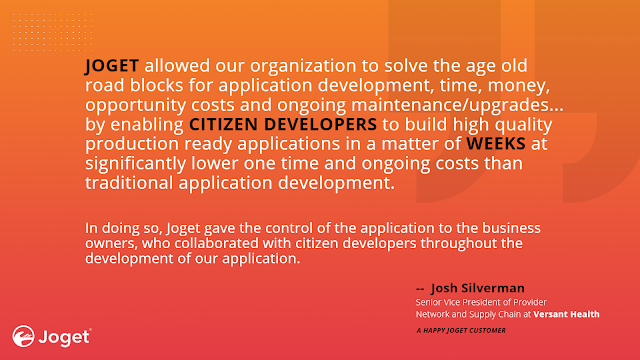
While researching the report, Forrester interviewed leaders from Joget, Inc. As a leading open source no-code/low-code platform, Joget provides a solid foundation for composable business applications. In the article Composable Business Applications Using Joget – Low Code, the team at
Mokxa Technologies, LLC shared how they implemented a composable, modular approach to develop apps related to assets, projects, budgets, policies, employees, clients and many more.
Joget provides different editions to cater to different feature and affordability needs. To learn more and get started with Joget, visit
https://www.joget.com.Other resources to help you get started:
Like this:
Like Loading...
Related