










Top Enterprises Using Joget

What is AI Governance?

AI governance is how an organization, in practice, decides who gets to build AI systems, what those systems are allowed to do, and how someone checks the work afterward.

It's less a single policy document and more a working system: assigned roles, review steps, technical guardrails, and logs that let you prove what happened when something goes wrong.

Quick Answer

AI governance establishes an organization's framework for managing the creation, operation, and oversight of its AI systems, including assigned roles, technical guardrails, and audit logs. This system is vital because trust remains a significant barrier to AI adoption; for instance, an IBM Institute for Business Value report found 80% of business leaders cite concerns about explainability, bias, ethics, or trust. By providing clear boundaries and accountability, AI governance enables organizations to deploy AI responsibly, fostering trust with customers and regulators.

How Does AI Governance Connect Intentions and Legal Requirements?

Governance connects intentions and legal requirements by establishing the actual mechanics that ensure good intentions and legal requirements are reflected in how an AI system behaves. Done well, governance moves beyond just downside protection, becoming a demonstrable asset when customers or regulators inquire about responsible AI use, and increasingly influencing business deals.

Why AI Governance Matters

Regulation is no longer optional

Every composable component is pre-validated. Security, access controls, and data handling are embedded in the building blocks — not added as an afterthought.

How Do AI Agents Change Enterprise Risk?

AI agents change enterprise risk because, unlike prototype-grade code, Joget's purpose-built components for enterprise environments are designed to handle integration complexity, heavy loads, and critical edge cases. This inherent robustness mitigates risks associated with unreliable or unscalable AI deployments, ensuring applications perform securely and predictably.

Trust is the real bottleneck

Trust is the real bottleneck. A report by the IBM Institute for Business Value found roughly 80% of business leaders point to concerns about explainability, bias, ethics, or trust, not a shortage of use cases, as the biggest thing holding back generative AI adoption.

A separate global study of over 48,000 people across 47 countries found the same gap from the other direction: 66% of people already use AI regularly, but only 46% say they actually trust it.

How Does AI Governance Enable Faster Innovation?

Teams that skip it don't actually ship quicker; they just find out about the risk later, usually after something's already live.

Clear boundaries set upfront let people build with confidence instead of second-guessing every decision, and that's what actually speeds delivery up.

Sources:

AI Governance in Joget

Joget is built on the idea that enterprises should be able to build and govern apps at the speed of business, without giving up control. That principle runs through every AI capability on the platform, across three layers that together cover an AI system's entire lifecycle.

Design-time

What's being built, by whom, at what cost

Runtime

What an agent does while it's running, and whether it's safe

Usage & cost

What it's costing you, platform-wide

Runtime governance

Guards and Execution Audit Trails

Applies to Agent Builder and AI Composer

Every message that touches an LLM inside Joget runs through a content safety pipeline first, both before it reaches the model and after the model responds.

When something trips a check, Joget can block the task, sanitize the content, or redirect execution to a safer path.

THE THREE GUARD TYPES:

LLM-Based Guard

Hands the safety decision to a second model, such as Llama Guard, running against a safety prompt you configure

Rule-Based Guard

Checks content against regex patterns and keyword blocklists. Redacts matches with [REDACTED] by default.

Webhook Guard

Posts content to your own external endpoint, which returns a straight safe or unsafe decision.

What the Execution Audit Trail logs

Every agent run is captured in full: who ran it, what ran, how it ran, and when. Click into any record and a node-by-node graph shows the full execution trace, with each node's request, response, and status.

If a run is still in progress, an Abort control sits right in the detail view, with a confirmation step before it stops the execution.

Design-time governance

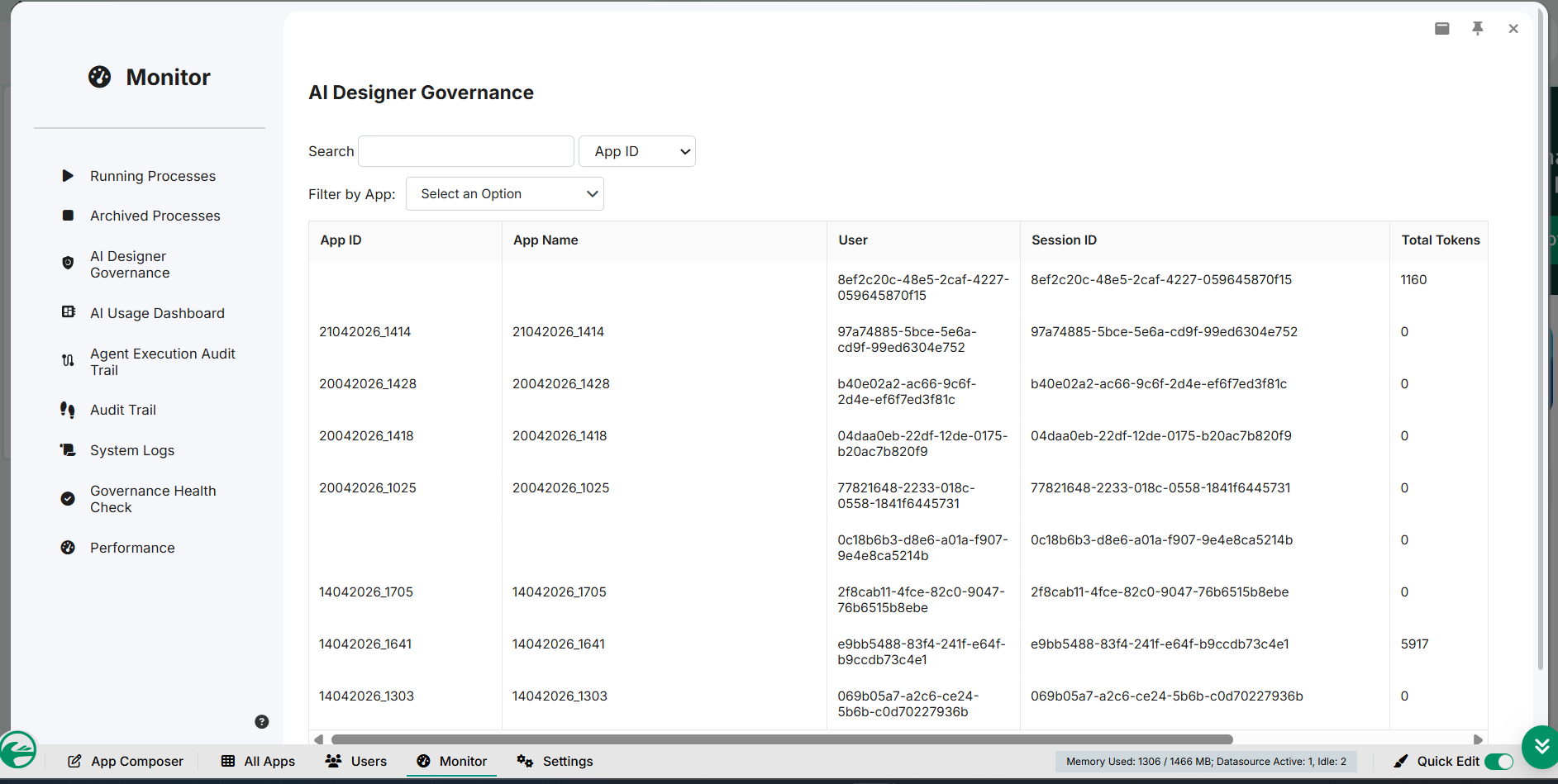
The AI Designer Governance Console

Applies to AI Designer, visible to Admins and System Managers

Governance doesn't wait for an agent to go live. Every AI Designer session, meaning every time someone uses AI to build or modify an app, is tracked from the moment it starts, down to which app, which user, and every individual LLM call made along the way, at what token cost.

App ID

App Name

User ID

Session ID

Total Tokens

Created At

Usage & cost governance

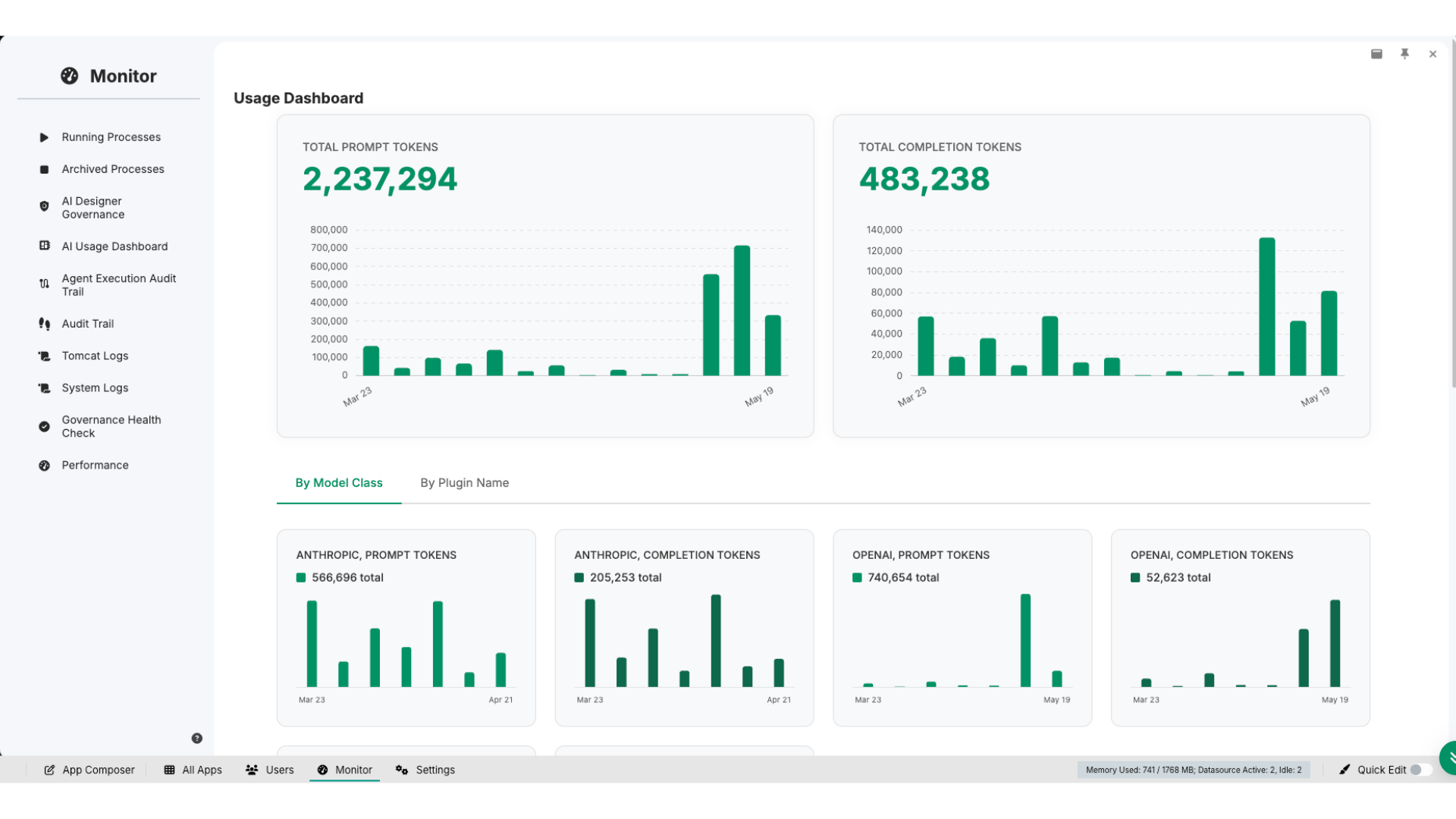
The AI Usage Dashboard

Platform-wide, visible to Admins and System Managers

Zoom out from a single session and you get the whole platform. Every LLM call made through Agent Builder, aggregated into trends you can actually act on, token usage over time, broken down by model and by plugin, so cost isn't a surprise you find out about at the end of the month.

What each system governs

Not every layer covers the same ground. Here's how they compare:

Concern Agent Builder AI Composer AI Designer
Content safety
Guards
(LLM / Rule / Webhook)
Guards
(LLM / Rule / Webhook)
Not applicable
Audit & traceability Execution Audit Trail Execution Audit Trail Governance Console
Token / cost tracking
Input / output
token counts
Input / output
token counts
Full breakdown
incl. cache tokens
Access control
System Manager (audit)
App Creator (execution)
System Manager (audit)
App Creator (execution)
System Manager only
Abort running execution Available Available Not applicable
Session tracking Run ID-based Run ID-based Session ID-based

Put together: design-time governance catches issues before an agent ever runs, runtime governance controls what it does while it's running, and usage governance keeps the cost of all of it visible. That's coverage across an AI system's entire lifecycle.

Implementing a Guardrail Layer in AI Agents

Learn how to actively control and sanitize AI agent outputs

This quick walkthrough shows you how to detect policy violations and trigger automated safety actions such as Blocking, Sanitizing, or Redirecting responses using custom LLM checks, specific word patterns, and external APIs.

How Can You See Joget AI Governance in Action on Your Use Case?

Bring one real AI workflow and we'll show you exactly what gets logged, guarded, and governed.

Frequently Asked Questions

What's the difference between AI governance and AI ethics?

AI ethics defines the values, like fairness and transparency. 

AI governance is the operational layer that turns those values into policies, approval workflows, and monitoring that actually get enforced.

Do AI agents need different governance than regular AI models?

Yes. Agents take actions, not just generate outputs, so governance has to cover execution permissions, autonomy levels, and real-time monitoring, not just content review.

Can a running AI agent in Joget be stopped mid-execution?

Yes. The Execution Audit Trail includes an Abort control with a confirmation step, right in the run detail view.

Who can see the AI Designer governance console?

Admins and System Managers. Every AI Designer session, and every LLM call inside it, is tracked from the moment it starts.
See How to Create an
Enterprise Ready App in less than 10 Mins

Get a Demo

See How top Enterprises Scale
with Joget

Customer Stories

Let our Sales Team Guide You
To Find the Perfect Joget Solution

Request Meeting

Become a Part of Our
Partner Network

Join the Network

Blog More...

\ Highlights \ April 24, 2026
Joget Introduces AI Composer for Conversational Enterprise App Composition with Built-in Governance

Joget AI Composer, conversational AI capabilities within Joget DX platform, enables development teams and business users to compose and modify…

Read
\ Insights \ February 20, 2026
AI Agent Adoption in 2026: What the Data Shows

Research and Forecasts from Gartner, Forrester, IDC, Deloitte, and Technology Leaders Note from writer: Originally published February 20, 2026. Updated…

Read
\ Update \ September 9, 2025
Joget Launches DX 9: AI-Driven Platform to Build Enterprise Apps Faster, Smarter, and at Scale

Joget Launches DX 9: AI-Driven Platform to Build Enterprise Apps Faster, Smarter, and at Scale New Release Combines AI Agent…

Read