
Research and Forecasts from Gartner, Forrester, IDC, Deloitte, and Technology Leaders
AI agents are moving out of the lab and into business operations. Not the chatbot kind you’re used to, these are systems that can plan a sequence of tasks, make decisions based on changing conditions, and execute work without constant supervision. They’re handling everything from invoice reconciliation to security monitoring, and the shift is happening faster than most organizations expected.
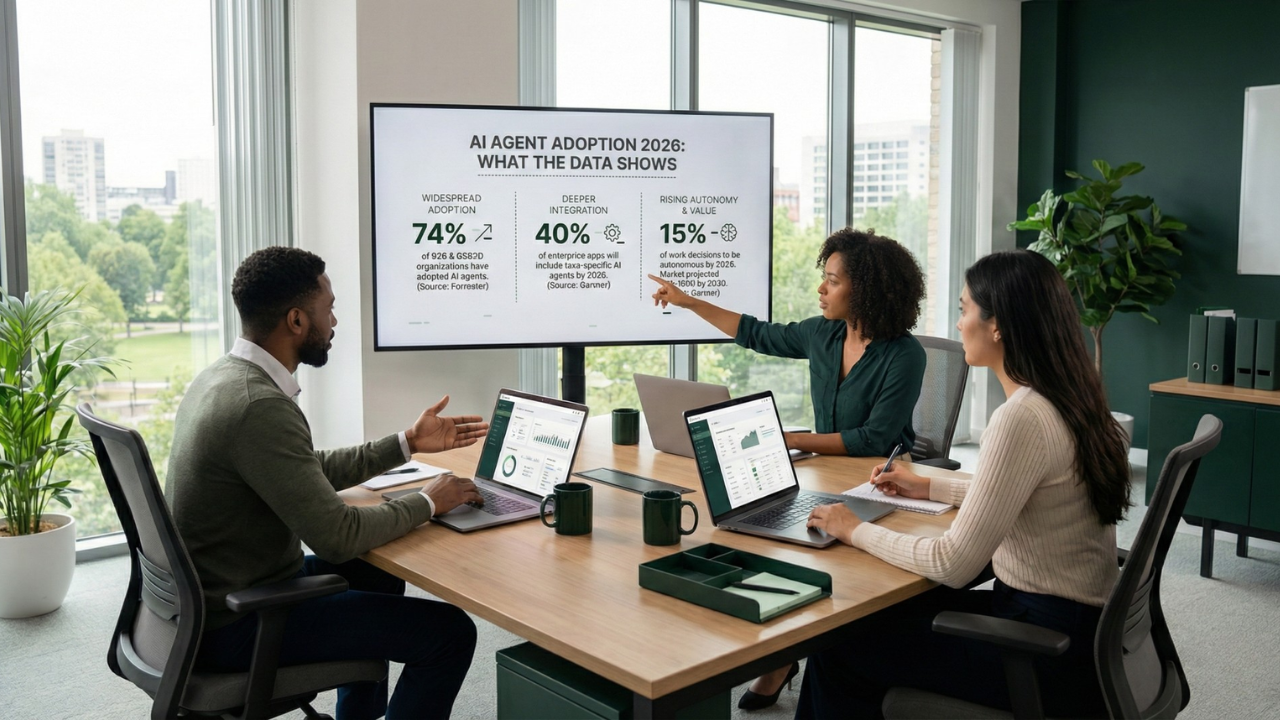
The major research firms (Gartner, Forrester, IDC, Deloitte), along with enterprise technology leaders, agree on this: 2026 is the year agents move from experimental projects to production deployments at scale. But there’s a catch.
More than 40% of these initiatives could be abandoned by 2027 if companies don’t get the fundamentals right around governance and return on investment.
Here’s what the latest research and field deployments tell us about where this is headed.
“By 2027, agentic automation will enhance capabilities in over 40% of enterprise applications.”
– IDC
The question isn’t whether a platform can integrate with AI tools. It’s whether the agent functionality is native to the system, which determines both capability and total cost of ownership.
Specialist Agents Are Learning to Work Together
The single-purpose agent model is already outdated. Both Forrester and Gartner see 2026 as the breakthrough year for multi-agent systems, where specialized agents collaborate under central coordination. One agent qualifies leads, another drafts personalized outreach, and a third validates compliance requirements. They maintain shared context and hand off work without human intervention.
…
“Multi-agent systems (MAS) are collections of AI agents that interact to achieve individual or shared complex goals. Agents may be delivered in a single environment or developed and deployed independently across distributed environments.”
– Gartner
…
Leaders at AWS and IBM point to orchestration layers as the critical infrastructure here, comparable to what Kubernetes did for container management. In practice, these systems are powering complex workflows like complete sales cycles and multi-stage incident response.
The strategic implication: organizations that invest in agent orchestration platforms now will have a significant operational advantage as these systems mature.

Image created with Nano Banana
Governance Will Determine Which Projects Survive
Here’s the uncomfortable truth from Gartner’s analysis: more than 40% of agent projects will fail by 2027. The reasons are predictable: runaway costs, unclear business value, and agents that behave in ways that violate policy or create risk. Because agents operate with a degree of autonomy, the potential for problems is constant. Bad data handling, policy violations, and unintended actions are all real risks.
The basics include real-time monitoring systems, kill switches that can halt agent actions immediately, and comprehensive audit trails. Industry executives recommend establishing clear policy guardrails and maintaining human oversight loops, especially in the early stages. Organizations that skip this step end up funding expensive experiments that produce no business value.
“In 2026, half of enterprise ERP vendors will launch autonomous governance modules. These modules combine explainable AI, automated audit trails, and real-time compliance monitoring.”
– Forrester
The Economics Demand Attention
Agents run continuously. They generate API calls, consume compute tokens, and accumulate cloud infrastructure costs around the clock. IDC is forecasting a 10x increase in agent usage and 1000x growth in inference demands by 2027.
The organizations getting this right are implementing tiered strategies: lower-cost models handle routine tasks, while premium models are reserved for high-stakes decisions. They’re tracking return on investment per agent and shutting down underperforming systems early.
This isn’t just about cost control. Companies that manage their economics well will turn agents into profit centers rather than budget drains.
“Agentic AI Surge: 10X Increase by 2027
The use of AI agents by G2000 companies is expected to increase tenfold, with agent-related API call loads rising a thousandfold.”
– IDC
Start Where the Returns Are Clearest
The pilot phase is over. Analysts are identifying specific use cases where agents are delivering measurable results in 2026:
Customer Service: Agents handling refunds, escalations, and omnichannel support are saving small teams 40+ hours monthly.
Finance and Operations: Automated invoicing, forecasting, and expense auditing are accelerating close processes by 30-50%.
Security and Governance: Anomaly detection and policy enforcement agents enable proactive risk reduction rather than reactive responses.
Sales and Marketing: Lead generation, personalized outreach, and qualification systems are producing 2-3x improvements in pipeline velocity.
These aren’t aspirational. They’re documented results from current deployments. Organizations should start with these proven applications to build momentum and gather data for broader implementation.
Physical Operations Are Next
Forrester is highlighting “physical AI” as an area to watch: agents that coordinate robots, sensors, and supply chain systems in real time. Applications include dynamic routing in warehouse operations and predictive maintenance for manufacturing equipment.
Leaders at Deloitte expect this to fundamentally change how industrial operations are managed by 2027.
For organizations in manufacturing or logistics, the combination of digital agents and edge hardware represents the highest-impact opportunity.

Image created with Nano Banana
Over half (58%) of respondents to Deloitte’s State of AI in the Enterprise survey said their companies are already using physical AI to some extent, and adoption is projected to hit 80% within two years.
– Deloitte
Your Workforce Needs New Skills (and Better Tools)
Agents augment human work rather than replace it. Both Gartner and Forrester emphasize that employees need training in how to design agent workflows, supervise their operation, and collaborate effectively with automated systems. New roles are emerging: agent architects, performance engineers, and oversight specialists.
But here’s what often gets overlooked: you don’t need a machine learning degree or a team of developers to start building agents. The organizations seeing the fastest returns are putting agent creation tools directly into the hands of business users who understand the problems best.
Visual, no-code platforms like Joget, with its Joget AI Agent Builder, are changing who can build autonomous systems. A customer service manager can design an agent that triages tickets and escalates complex cases. A finance lead can create an agent that matches invoices and routes approvals. An IT director can deploy agents that monitor infrastructure and execute standard procedures. No coding required.
The results speak for themselves. Teams reclaim hours previously spent on manual coordination. Processes that took days now finish in minutes. Employees shift from data entry to work that requires judgment and creativity.
“According to IDC, In-app AI agents and greater use of no-code/low-code agentic orchestration platforms will make it easier than ever to deploy new agents.”
This approach also breaks the cycle of endless pilots. When the people who understand the business problem can build the solution themselves, deployment happens in weeks instead of quarters.
Governance gets built into the design process because the business users creating the agents are accountable for the outcomes.
By 2026, fluency with agent systems will be as fundamental as spreadsheet skills are today. Organizations that combine training with accessible tools will avoid the capability gaps that slow adoption.
What This Means for Your Organization
The research is consistent: 2026 is the year agents transition from experimental technology to operational infrastructure. But Gartner’s warning about project failure rates should be taken seriously. Undisciplined adoption leads to abandoned initiatives and wasted investment.
The path forward is clear. Focus on governed pilots in areas with documented ROI. Get your data infrastructure right before scaling. Measure everything and be willing to shut down what doesn’t work.
Success comes from treating agents as accountable systems with clear responsibilities, not as solutions to poorly defined problems. Organizations that understand this will build significant competitive advantages. Those who don’t will fund expensive learning experiences.
What’s your organization’s first move?
Moving From Research to Reality With the Right Platform
The analyst’s forecasts paint a clear picture: AI agents are becoming essential infrastructure, not experimental technology. But as the research also shows, execution separates winners from those who waste budget on failed pilots.
This is where platform selection becomes critical. Organizations need tools that balance three requirements the analysts keep emphasizing: speed to deployment, governance and oversight, and accessibility for business users who understand the problems best.
Joget: Built for the Agent Era
Joget is an AI-powered, open-source application platform designed specifically for this transition. The Joget Intelligence AI Suite addresses the core challenges highlighted throughout this article.
Through the vibe composition approach featuring Joget AI Designer, teams can generate enterprise applications using natural language, documents, or images. No coding required. This tackles the skills gap problem directly by making app creation accessible to business users.
The Joget AI Agent Builder puts autonomous agent creation into the hands of the people who know the workflows. Customer service managers can build agents that triage tickets and escalate complex cases. Finance teams can create agents that match invoices and route approvals. IT directors can deploy agents that monitor infrastructure and execute standard procedures. All through a visual interface.
Critically, Joget addresses the governance concerns that Gartner warns will sink 40% of projects. Agents operate within structured, auditable workflows with human-in-the-loop controls for critical decisions. You get autonomy without losing oversight. Speed without sacrificing responsibility.
The platform is infrastructure-agnostic, running on private cloud, public cloud, hybrid, or on-premise environments. Its open-source foundation and extensible plugin architecture mean you can connect to legacy systems and modern APIs without vendor lock-in.
Organizations using Joget are already seeing the returns analysts predict: processes that took days now complete in minutes, teams reclaiming many hours monthly from automated workflows, and faster deployment cycles measured in weeks rather than quarters.
Most importantly, the visual-first approach ensures applications remain maintainable and governed, avoiding the technical debt that accumulates when agents are built through raw code generation. Every agent is embedded in a workflow where humans set the rules and retain final authority.
Ready to Start?
The data from Gartner, Forrester, IDC, and enterprise leaders is consistent: 2026 is the year to move agents from pilots to production. The organizations that succeed will be those that combine accessible technology with proper governance and a clear ROI focus.
Visit joget.com to learn how Joget Intelligence can help your organization build, deploy, and govern AI agents at scale, without compromise.
Frequently Asked Questions (FAQ) About Agentic AI
What is Agentic AI?
Agentic AI refers to artificial intelligence systems designed to operate autonomously with goal-directed behavior.
Unlike traditional AI that requires explicit instructions for each task, agentic AI can plan, make decisions, use tools, and execute multi-step tasks to achieve objectives with minimal human supervision.
Think of it as a digital team member that can perceive its environment, reason through problems, and take action independently.
How does Agentic AI work?
- Agentic AI operates through a four-stage process: First, it perceives data from its environment and extracts meaningful information.
- Second, it uses large language models (LLMs) to reason through the context, develop an action plan, and adapt in real time.
- Third, it maintains memory of past actions and context to ensure consistency.
- Finally, it takes action by directly interacting with external systems through APIs and tools to accomplish its goals.
What is the difference between Agentic AI and Generative AI?
The main difference lies in autonomy and purpose. Generative AI is reactive—it creates content (text, images, code) in response to prompts but requires human direction for each output. Agentic AI is proactive—it can independently plan and execute a series of steps to achieve goals without constant human input.
While generative AI generates content, agentic AI gets things done. However, they often work together: agentic systems frequently use generative AI as a tool within broader workflows.
What are the benefits of using Agentic AI?
Organizations using agentic AI report several key benefits: significant time savings (teams reclaim 40+ hours monthly on routine tasks), faster process completion (tasks that took days now finish in minutes), reduced operational costs through automation, 24/7 operation without breaks, improved accuracy in repetitive tasks, and freed-up employee time for strategic work.
McKinsey predicts AI agents could add $2.6 to $4.4 trillion in value annually across various business use cases.
What are common use cases for Agentic AI?
Proven use cases in 2026 include: Customer service (autonomous ticket resolution, refunds, escalations), Finance and operations (invoice matching, expense auditing, forecasting), Security and compliance (threat detection, policy enforcement, anomaly detection), Sales and marketing (lead generation, personalized outreach, pipeline management), Supply chain (inventory optimization, route planning, demand forecasting), and HR (resume screening, interview scheduling, candidate evaluation).
Is Agentic AI the same as AI agents?
Not exactly. An “AI agent” refers to the individual software component that can act autonomously. “Agentic AI” describes the broader system or approach that uses these agents.
A single agentic AI system often includes multiple specialized AI agents working together under coordination. For example, one agent might handle data analysis while another manages communication—together, they form an agentic AI system.
What are the risks of Agentic AI?
Key risks include: autonomous agents making unintended decisions that violate policies, potential for agents to misinterpret goals and optimize for the wrong outcomes, runaway costs from continuous operation without proper monitoring, data security concerns when agents access multiple systems, lack of transparency in decision-making processes, and governance challenges. Gartner predicts over 40% of agentic AI projects will fail by 2027 due to these issues if proper controls aren’t established.
Do I need technical expertise to build AI agents?
Not anymore. While traditional agent development required programming skills, modern no-code platforms now allow business users to design and deploy AI agents through visual interfaces. Tools like Joget AI Agent Builder enable customer service managers, finance leads, and operations teams to create agents without writing code. This democratization of agent development is accelerating adoption across organizations.
How is Agentic AI different from traditional automation?
Traditional automation follows rigid, predefined rules and cannot adapt to unexpected situations. Agentic AI can reason through problems, make contextual decisions, learn from outcomes, and adjust its approach based on changing conditions. While traditional automation breaks when faced with exceptions, agentic systems can handle ambiguity and novel situations by applying reasoning capabilities similar to human problem-solving.
What industries are adopting Agentic AI?
Early adopters span multiple sectors: Financial services (fraud detection, trading, compliance), Healthcare (treatment planning, diagnostics, patient coordination), Manufacturing (supply chain optimization, predictive maintenance), Retail and e-commerce (personalized shopping, inventory management), Technology companies (software development, security operations), and Professional services (research, document processing, client management).
Forrester and Deloitte expect significant expansion into physical operations and logistics by 2027.
References
Gartner
40% of enterprise apps with AI agents by 2026:
https://www.gartner.com/en/newsroom/press-releases/2025-08-26-gartner-predicts-40-percent-of-enterprise-apps-will-feature-task-specific-ai-agents-by-2026-up-from-less-than-5-percent-in-2025
40% of agentic AI projects will fail by 2027:
https://www.gartner.com/en/newsroom/press-releases/2025-06-25-gartner-predicts-over-40-percent-of-agentic-ai-projects-will-be-canceled-by-end-of-2027
Gartner Top Strategic Technology Trends for 2026:
https://www.gartner.com/en/newsroom/press-releases/2025-10-20-gartner-identifies-the-top-strategic-technology-trends-for-2026
Strategic Predictions for 2026:
https://www.gartner.com/en/articles/strategic-predictions-for-2026
Forrester
Predictions 2026: AI Agents, Enterprise Software:
https://www.forrester.com/blogs/predictions-2026-ai-agents-changing-business-models-and-workplace-culture-impact-enterprise-software/
Predictions 2026: AI Moves From Hype To Hard Hat Work:
https://www.forrester.com/blogs/predictions-2026-ai-moves-from-hype-to-hard-hat-work/
Forrester Predictions 2026 Hub:
https://www.forrester.com/predictions/
IDC
IDC FutureScape 2026 Main Press Release:
https://my.idc.com/getdoc.jsp?containerId=prUS53883425
Agent Adoption: The IT Industry’s Next Great Inflection Point:
https://www.idc.com/resource-center/blog/agent-adoption-the-it-industrys-next-great-inflection-point/
FutureScape 2026: Moving into the agentic future:
https://www.idc.com/resource-center/blog/futurescape-2026-moving-into-the-agentic-future/
Asia/Pacific CIO Agenda 2026:
https://www.idc.com/resource-center/blog/asia-pacific-cio-agenda-2026-predictions-agentic-ai/
Deloitte
State of AI in the Enterprise 2026:
https://www.deloitte.com/us/en/about/press-room/state-of-ai-report-2026.html
2026 Manufacturing Industry Outlook:
https://aimagazine.com/news/ai-to-redefine-manufacturing-competitiveness-in-2026
Physical AI: Tech Trends 2026:
https://www.deloitte.com/us/en/insights/topics/technology-management/tech-trends/2026/physical-ai-humanoid-robots.html
TMT Predictions 2026:
https://www.deloitte.com/us/en/insights/industry/technology/technology-media-and-telecom-predictions.html
Agentic, Physical, and Sovereign AI: 2026 Predictions (Middle East):
https://www.deloitte.com/middle-east/en/services/consulting/perspectives/2026-ai-predictions-shaping-the-middle-east.html
Mckinsey & Company
Seizing the agentic AI advantage
https://www.mckinsey.com/capabilities/quantumblack/our-insights/seizing-the-agentic-ai-advantage
IBM
2026 Goals for AI & Technology Leaders:
https://www.ibm.com/think/insights/2026-resolutions-for-ai-and-technology-leaders
The trends that will shape AI and tech in 2026:
https://www.ibm.com/think/news/ai-tech-trends-predictions-2026
Enterprise Advantage Service Launch:
https://newsroom.ibm.com/2026-01-19-ibm-launches-enterprise-advantage-service-to-help-businesses-scale-agentic-ai
Scaling agentic AI on AWS with IBM Consulting:
https://www.ibm.com/new/product-blog/scaling-agentic-ai-on-aws-with-ibm-consulting-advantage-for-agentic-applications
AWS
IBM and AWS: Driving outcomes through AI-powered transformation:
https://www.cio.com/article/4107138/ibm-and-aws-driving-outcomes-through-ai-powered-transformation-and-industry-expertise.html
Business 2.0
Future of Work with AI Agents in 2026: 10 Use Cases for Entrepreneurs, Enterprises, and Large MNCs
https://business20channel.tv/future-work-ai-agents-2026-10-use-cases-entrepreneurs-enterprises-mncs-7-december-2024
Codewave
The State of AI Enterprise Adoption in 2026
https://codewave.com/insights/ai-enterprise-adoption-2026/
Related